Walk into any gym and you’ll find two tribes. One lives on the treadmill, sure that sweating buckets is the only honest way to burn fat. The other never touches cardio, certain that lifting is all that counts. Both are partly right, and both are missing the part that matters most.
This is one of the most common questions I hear from people starting out: should I do cardio or lift weights to lose fat? It feels like it should have a one-word answer. It doesn’t. But it has an honest one, and the honest version is far more useful than the gym-bro answer from either camp. So let’s go through what the research really shows, where it’s solid, and what it means for the body you actually want.
First, one thing has to be on the table, because everything else hangs on it.
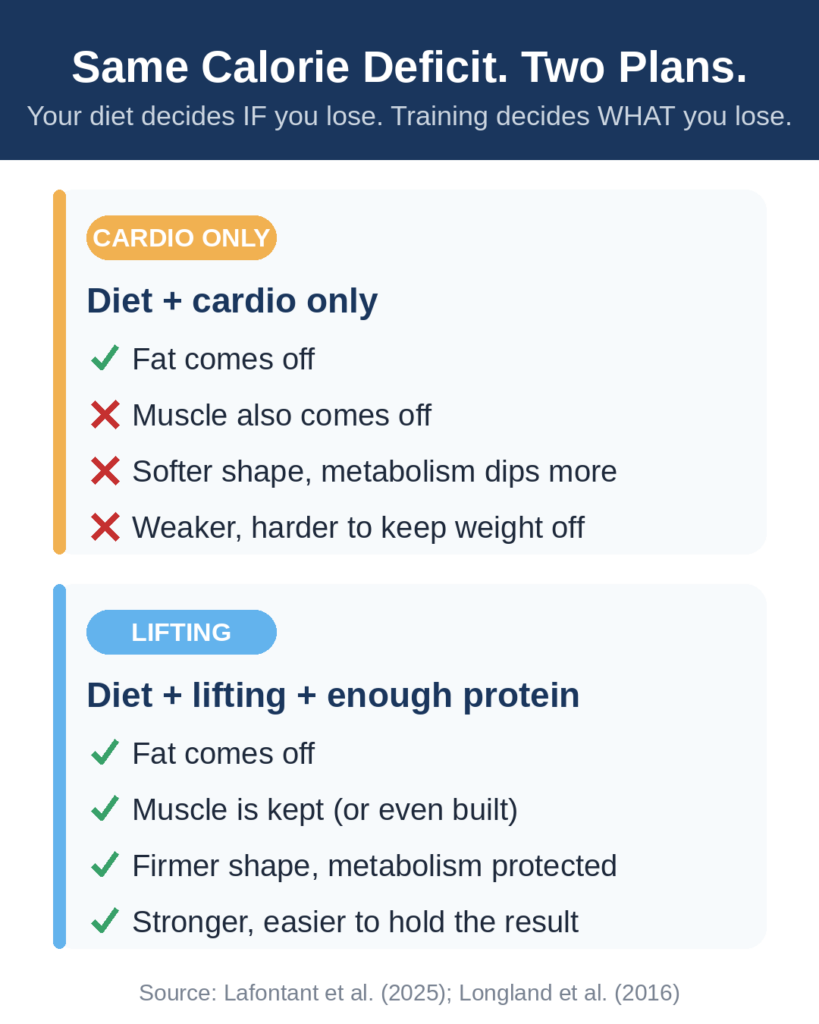
Neither one “burns fat” on its own. The deficit does.
Fat loss runs on a single rule. You have to take in less energy than your body uses. That’s a caloric deficit, and it isn’t a philosophy, it’s thermodynamics. Exercise can help you build that deficit and shape what happens inside it, but no amount of running or lifting cancels out eating more than you burn.
Keep that in the back of your mind, because it quietly changes how you read everything below. The real question was never “which exercise burns fat.” It’s “which kind of training helps me lose the right weight while I’m in a deficit.” Those are two very different questions, and most people are arguing about the first when they should be asking the second. If you want a rough idea of how many calories your body burns in a day to set that deficit, you can estimate it with my free calorie calculator.
On the scale, cardio usually wins by a little
Let’s start with what the cardio crowd gets right. If your only scoreboard is the number on the scale, steady cardio tends to pull slightly ahead.
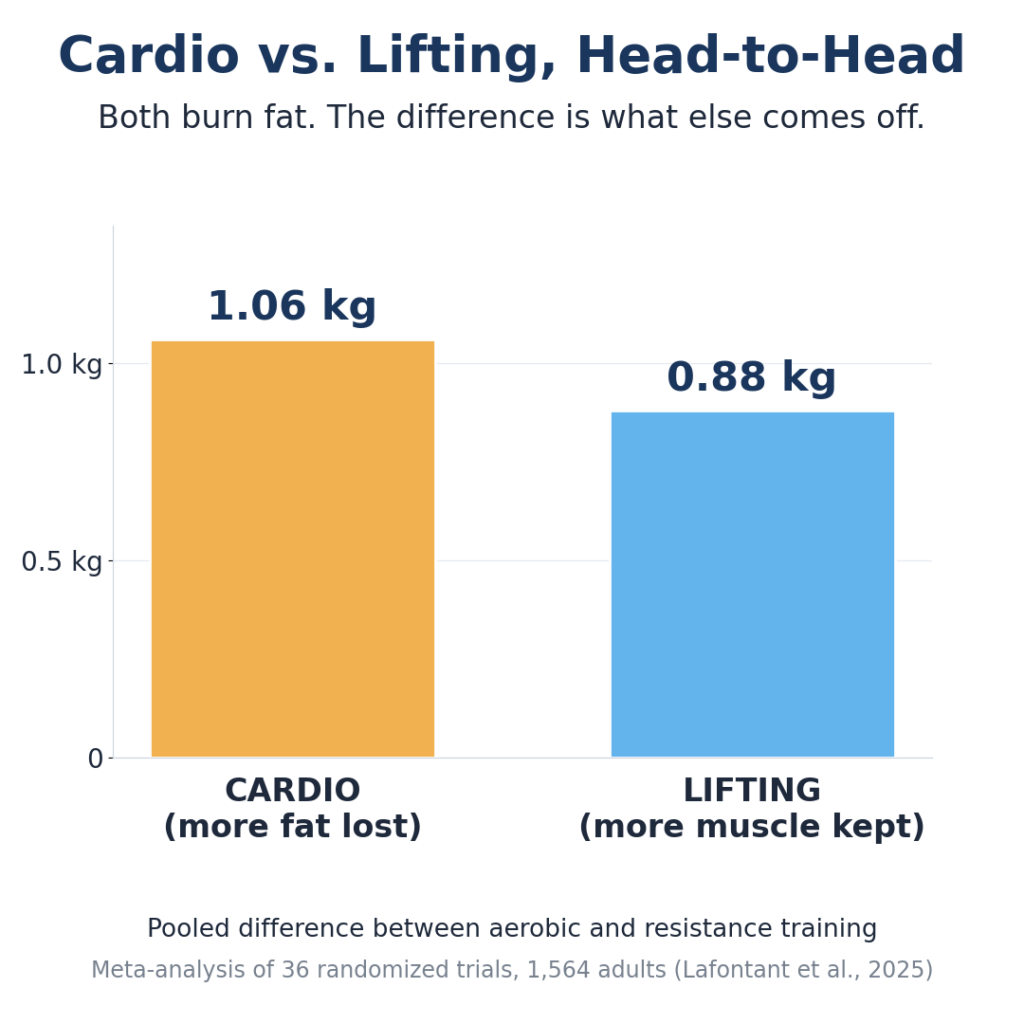
A 2025 review pooled 36 randomized controlled trials and more than 1,500 adults, comparing aerobic training, resistance training, and the two combined (Lafontant et al., 2025). Head to head, aerobic training produced more weight loss than lifting, about 1.8 kg more on average, and took off more fat, roughly 1 kg more.
That makes sense. A hard cardio session usually burns more calories in the moment than the same minutes spent lifting, where you rest between sets. More calories out, a bigger dent in the deficit, more weight gone. So far the treadmill tribe looks vindicated.
But the scale never tells you what you lost. And that’s where the story turns.
The catch: some of that “extra” loss is muscle
Here’s the number almost nobody hears. In that same analysis, the weight people lost through cardio included more lean mass, your muscle, than the weight lost through lifting. Resistance training held onto roughly 0.88 kg more muscle than aerobic training did over the same stretch (Lafontant et al., 2025).
Read that next to the fat numbers and the picture flips. Cardio took off a little more fat, true, but it also gave up more muscle to get there. Lifting lost slightly less on the scale, and what it kept was exactly the tissue you want to protect.
Why does that matter so much? For two reasons that have nothing to do with vanity.
The first is shape. Muscle is what gives your body its lines. Two people can weigh the same and look completely different depending on how much muscle sits under the fat. Lose fat and muscle together and you end up lighter but soft, the “skinny-fat” result people complain about after a crash diet. Lose fat while holding muscle and that same weight reads firmer and healthier.
The second is function and metabolism. When you shed a lot of lean mass, you burn a bit less at rest and you get weaker, which makes the whole process harder to keep up. Protecting muscle during a diet is one of the quietest predictors of whether you’ll actually hold the result a year later.
What lifting really does (and a myth I want to put down)
Resistance training has earned its place in the body composition research. A 2022 systematic review and meta-analysis found that lifting on its own, without a single minute of cardio, lowered body fat percentage, total fat mass, and the visceral fat packed around your organs (Wewege et al., 2022). You can lose fat by lifting. Full stop.
Now let me push back on something the lifting crowd tends to oversell. You’ll hear that adding muscle “turns your body into a furnace” and lets you eat whatever you want. That’s a stretch. Each pound of muscle you build burns only a handful of extra calories a day at rest, not hundreds. Muscle is worth protecting, but it doesn’t rewrite energy balance, and it doesn’t replace the deficit.
The honest value of lifting in a diet is simpler than the furnace story. It signals your body to keep the muscle it already has, so the weight you lose comes mostly from fat. That’s the job, and it does it well.
It even works in steep deficits. In one tightly controlled trial, young men ate at an aggressive 40% calorie deficit for four weeks while lifting and sprinting. The group eating enough protein gained about 1.2 kg of muscle while losing 4.8 kg of fat, at the same time (Longland et al., 2016). Building muscle while losing fat isn’t supposed to be easy, and for experienced lifters it goes much slower. But it shows what becomes possible when you give the body a reason to hold muscle and the protein to do it.
So why not just do both?
If you’ve been waiting for me to say “do both,” here it is, with the evidence underneath it.
When you stack cardio and lifting together, you tend to get the best of each: the calorie burn and fat loss from cardio, plus the muscle protection from lifting. A network meta-analysis of adults with overweight and obesity ranked the different modes and found aerobic work came out best for raw weight and BMI, while high-intensity interval work did more for waist size and body fat percentage (Wang et al., 2024). Different tools, different strengths, and using both covers more ground than either alone.
There’s a nuance here I won’t gloss over, though. Some of combined training’s apparent edge may come simply from doing more total work. When studies carefully match the amount of exercise between groups, the gap between “combined” and “resistance alone” narrows and often disappears for fat and muscle (Khalafi et al., 2025). In plain terms, a lot of the benefit isn’t magic from mixing the two. It’s just volume. More training, done consistently, tends to win.
Which brings me to the part that actually decides this.
The honest verdict
If I had to rank these for someone whose goal is to lose fat and feel better in their body, this is how I’d put it.
Lifting is the foundation, because it protects the muscle that protects your result. Cardio is the complement that earns its place, because it adds to your deficit and does things for your heart and your stamina that lifting can’t touch. Run together, they cover each other’s blind spots. And sitting under both of them is the deficit, which is what turns any of this into fat loss in the first place.
But the variable that matters most isn’t on a single chart above. It’s whether you’ll keep doing it. The best training split in the world does nothing if you quit in three weeks. If you genuinely hate running, daily cardio sessions will not survive contact with your real life, and you’d be better off lifting and simply walking more. If lifting bores you, there are plenty of ways to train strength that never involve a barbell. The “best” plan for fat loss is the one you can repeat for months, not the one that looks sharpest on paper for a week.
That isn’t a cop-out. It’s the piece the studies can’t measure, and the piece that decides almost everything over the long run.
How to actually put this together
A few practical points to take with you:
Build your week around resistance training first. Two to four sessions that hit the major muscle groups. Think of this as your muscle insurance while you diet.
Add cardio as a complement, not the main event. A few sessions of something you can stand, plus walking more across the day, adds up to more than people expect.
Eat enough protein. This is the thing that lets lifting actually preserve muscle in a deficit. Skip it and you lose most of the benefit.
Anchor all of it to the deficit. Training shapes what you lose. Your diet decides whether you lose at all. You can map out your starting numbers with my free calculator.
And give it real time. Honest changes in body composition take months, not days. This is a long game, and the people who win it are the ones who stop hunting for the shortcut and start showing up.
If you’d rather have a plan built around your body, your schedule, and your starting point instead of a generic template, that’s exactly the work I do with clients inside one-on-one nutrition coaching. And if you want to learn the principles and apply them yourself first, my books and courses walk through all of it, step by step.
Cardio or weights was never really the question. Protecting your muscle while you lose fat, on top of a deficit you can actually sustain, is. Get that part right and the rest tends to take care of itself.
References
KHALAFI, M. et al. The effects of concurrent training versus aerobic or resistance training alone on body composition in middle-aged and older adults: a systematic review and meta-analysis. Healthcare, v. 13, n. 7, p. 776, 2025. DOI: 10.3390/healthcare13070776.
LAFONTANT, K. et al. Comparison of concurrent, resistance, or aerobic training on body fat loss: a systematic review and meta-analysis. Journal of the International Society of Sports Nutrition, v. 22, n. 1, art. 2507949, 2025. DOI: 10.1080/15502783.2025.2507949.
LONGLAND, T. M. et al. Higher compared with lower dietary protein during an energy deficit combined with intense exercise promotes greater lean mass gain and fat mass loss: a randomized trial. The American Journal of Clinical Nutrition, v. 103, n. 3, p. 738-746, 2016. DOI: 10.3945/ajcn.115.119339.
WANG, H. et al. Comparative efficacy of exercise training modes on systemic metabolic health in adults with overweight and obesity: a network meta-analysis of randomized controlled trials. Frontiers in Endocrinology, v. 14, art. 1294362, 2024. DOI: 10.3389/fendo.2023.1294362.
WEWEGE, M. A. et al. The effect of resistance training in healthy adults on body fat percentage, fat mass and visceral fat: a systematic review and meta-analysis. Sports Medicine, v. 52, n. 2, p. 287-300, 2022. DOI: 10.1007/s40279-021-01562-2.