Green tea that “torches fat.” Chili peppers that “fire up your metabolism.” Ice water, apple cider vinegar, ginger, that one expensive tea your favorite influencer swears by. The promise is always the same and always seductive: eat or drink the right thing, and your body will burn more calories on its own, no effort required.
It’s one of the most profitable ideas in the wellness industry, because it sells the dream of fat loss without the work. And buried inside it is a tiny grain of truth, which is exactly what makes it so effective as marketing.
So let’s separate that grain of truth from the mountain of nonsense piled on top of it. Does food affect your metabolism? Yes, a little. Does any food “boost” it enough to matter for fat loss? That’s the question the science answers clearly, and the answer is going to save you a lot of money on teas that do nothing.
First, what “metabolism” actually means
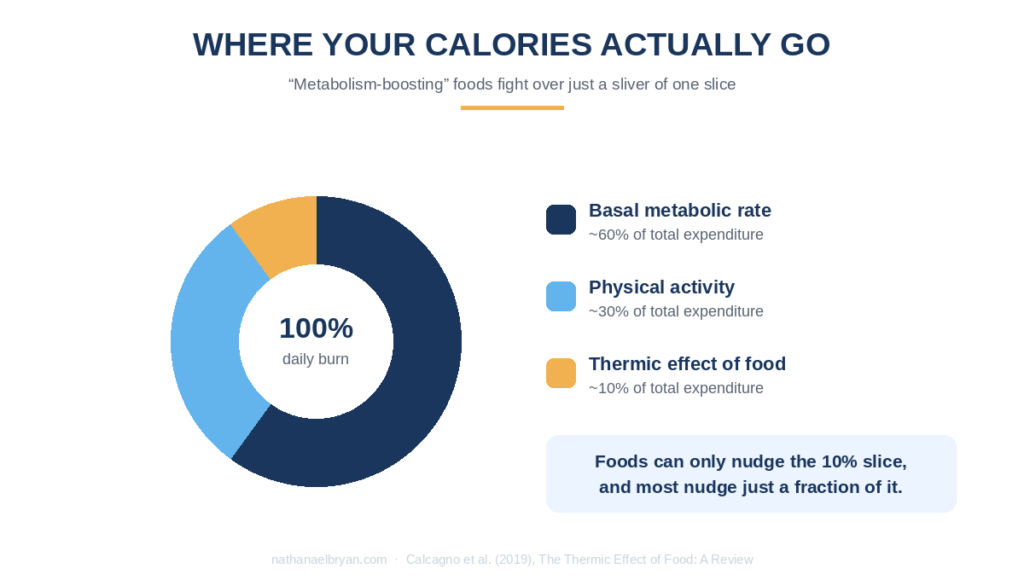
When people say they want to “boost their metabolism,” they usually mean they want to burn more calories. So let’s look at where your calories actually go each day. Your total daily energy expenditure has four parts.
The biggest by far is your basal metabolic rate, the energy to keep you alive at rest, which is roughly 60% of the total and is driven largely by your body size and how much muscle you carry. Then there’s physical activity, both intentional exercise and the incidental movement of daily life. And finally, the part everyone fixates on: the thermic effect of food, also called diet-induced thermogenesis.
The thermic effect of food is the energy your body spends digesting, absorbing, and processing what you eat. According to a systematic review by Calcagno and colleagues (2019), it accounts for only about 10% of your total daily energy expenditure (CALCAGNO et al., 2019). That’s the entire budget that “metabolism-boosting foods” are fighting over. Not your whole metabolism, just a sliver of that 10% slice. Keep that proportion in mind, because it’s the key to everything below.
The grain of truth: food does have a thermic effect
Here’s the part that’s real, and that the marketing is built on. Different foods do cost different amounts of energy to process, and one macronutrient genuinely stands out.
That systematic review found that the energy content and composition of a meal both influence its thermic effect. Larger meals produce a larger thermic response, and meals high in protein or carbohydrate produce a higher thermic effect than high-fat meals (CALCAGNO et al., 2019). Protein is the clear winner here. Your body spends a meaningfully larger fraction of protein’s calories just breaking it down compared to fats or carbs.
So yes, in a strict technical sense, protein “boosts your metabolism” more than other foods. But notice what’s actually happening. This isn’t some magic ingredient revving an engine. It’s just the metabolic cost of digestion, and it’s a real but modest effect that I covered in depth in my article on how much protein you actually need. Protein earns its place in a fat-loss diet for this and several other reasons. But that’s a far cry from the fat-melting promises attached to teas and spices.
The mountain of nonsense: green tea, caffeine, and the “fat-burning” teas
Now to the products actually being sold to you. The poster child of the “metabolism-boosting” world is green tea, usually paired with caffeine. Does it work?
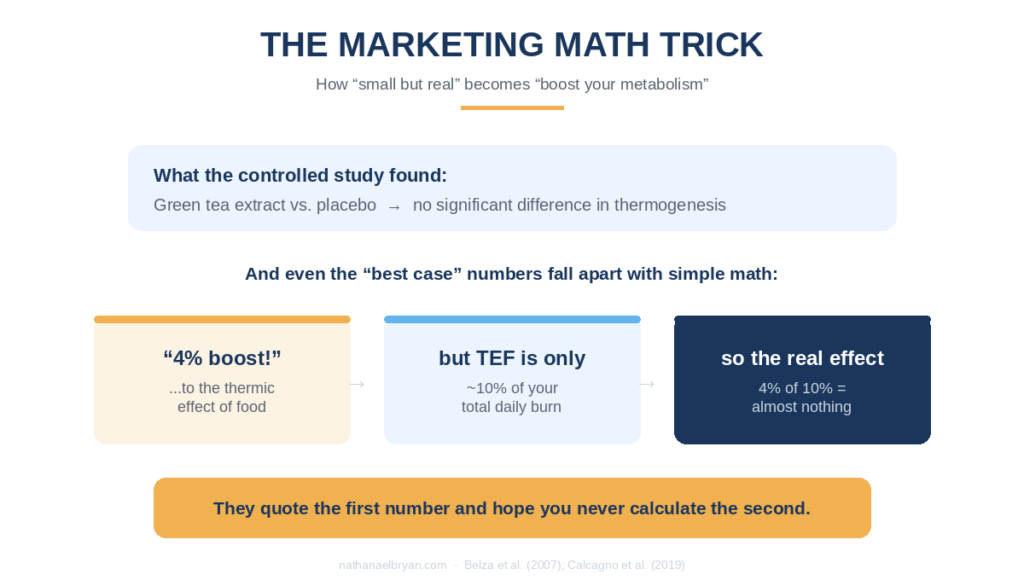
The honest answer is: technically measurable, practically irrelevant. A well-controlled study by Belza and colleagues (2007) tested this directly. In a randomized, double-blind, placebo-controlled crossover trial, they gave healthy men green tea extract, tyrosine, caffeine, or placebo, and measured the thermogenic response over the following hours. The result is telling. The green tea extract produced a thermogenic response that was not significantly different from placebo (BELZA; TOUBRO; ASTRUP, 2007). The green tea, by itself, essentially did nothing measurable.
Caffeine fared a little better in that study, producing a roughly 6% short-term bump in energy expenditure (BELZA; TOUBRO; ASTRUP, 2007). But before you celebrate, do the math on what that actually means in the real world. A small, temporary percentage increase on your resting burn, over a few hours, translates to a handful of calories. We’re talking about an amount of energy you could erase with three or four bites of food, and the effect fades, and your body partly adapts to caffeine over time.
Some studies have found a small effect from green tea combined with caffeine on 24-hour energy expenditure, on the order of a few percent. But even taking the most generous findings at face value, the magnitude is tiny relative to your total daily burn, easily swamped by normal day-to-day variation in how much you move and eat. No one ever lost a meaningful amount of fat because of a cup of tea, and the controlled evidence is clear that you shouldn’t expect to.
Why “small but real” is the most dangerous phrase in nutrition marketing
This is the heart of the matter, and it’s a lesson that goes far beyond tea.
The supplement and wellness industry has mastered a particular trick: find an effect that is real but trivially small, then describe it with language that implies it’s large. “Clinically shown to boost metabolism” can technically be true of something that raises your daily burn by fifteen calories, an amount so small it’s meaningless for fat loss, and well within the margin of error of everything else in your day.
A 4% bump in the thermic effect of food sounds impressive until you remember the thermic effect is only 10% of your total expenditure to begin with. Four percent of ten percent is almost nothing. The marketing quotes the first number and hopes you never work out the second.
This is precisely why I keep coming back to the fundamentals. The things that genuinely move your total energy expenditure are not teas or spices. They are the size of your body, the muscle you carry, and how much you move. Building muscle through resistance training and increasing your daily activity will do more for your metabolism than every “fat-burning” product ever marketed, combined. And the only thing that reliably creates fat loss is a sustained caloric deficit, the mechanism I walk through fully in my article on how fat loss actually works.
What about chili, cold water, vinegar, and the rest?
The same logic dismantles the entire category, one fashionable claim at a time.
Capsaicin, the compound in chili peppers, does produce a small, measurable thermogenic effect and may slightly blunt appetite. Real, and genuinely trivial in magnitude. Cold water forces your body to spend a little energy warming it to body temperature, an effect so small it’s almost comical to count. Apple cider vinegar has no meaningful thermogenic effect at all; its modest reputation comes from possible small effects on appetite and blood sugar, not from “boosting metabolism.”
In every single case the pattern repeats. There’s either no real effect, or an effect so small that it disappears into the noise of normal daily life. None of them is a tool for fat loss. They are, at best, footnotes, and at worst, distractions that pull your attention away from the things that actually work.
What this means for you, practically
Strip away the marketing and the guidance is simple, honest, and free.
Stop spending money on “metabolism-boosting” products. The teas, the powders, the fat-burner pills, the detox blends. The controlled evidence says their effect on your metabolism ranges from nonexistent to trivial. That money is far better spent on quality protein.
Use the one real lever food gives you: protein. It has the highest thermic effect of any macronutrient, it protects your muscle, and it keeps you full. Prioritizing protein is the legitimate version of “eating for your metabolism,” and it’s the only version backed by solid evidence.
Build the things that actually raise your metabolism. More muscle and more daily movement genuinely increase how many calories you burn, by amounts that dwarf anything a tea can offer. That’s where your effort belongs.
And anchor everything to the real mechanism. Fat loss comes from a sustained caloric deficit, supported by enough protein and a pattern you can maintain. No food overrides that, and no food replaces it. A “metabolism-boosting” food that lets you burn an extra fifteen calories is irrelevant next to the fundamentals.
The honest truth, once again, is less exciting than the promise on the label. There is no tea that melts fat, no spice that turns your body into a furnace, no drink that does the work for you. But there is something better than a false promise: a real one. Build muscle, move more, eat enough protein, hold a sustainable deficit, and your body will do exactly what you wanted the tea to do, for real this time.
If you want help building a plan around these fundamentals, tailored to your body and your life rather than the latest fad, that’s the work I do with my patients, individualized and adjusted over time. You can see how my coaching works here. If you’d rather start by learning the fundamentals yourself, my educational materials are here, and you can estimate your own numbers with my free calculator.
References
BELZA, A.; TOUBRO, S.; ASTRUP, A. The effect of caffeine, green tea and tyrosine on thermogenesis and energy intake. European Journal of Clinical Nutrition, v. 63, n. 1, p. 57–64, 2007. Available at: https://www.nature.com/articles/1602901. Accessed: 16 jun. 2026.
CALCAGNO, M.; KAHLEOVA, H.; ALWARITH, J. et al. The thermic effect of food: a review. Journal of the American College of Nutrition, v. 38, n. 6, p. 547–551, 2019. Available at: https://pubmed.ncbi.nlm.nih.gov/31021710/. Accessed: 16 jun. 2026.
HURSEL, R.; WESTERTERP-PLANTENGA, M. S. Thermogenic ingredients and body weight regulation. International Journal of Obesity, v. 34, n. 4, p. 659–669, 2010. Available at: https://pubmed.ncbi.nlm.nih.gov/20142824/. Accessed: 16 jun. 2026.
WESTERTERP, K. R. Diet induced thermogenesis. Nutrition & Metabolism, v. 1, n. 1, p. 5, 2004. Available at: https://pmc.ncbi.nlm.nih.gov/articles/PMC524030/. Accessed: 16 jun. 2026.