Few things in nutrition have been sold harder than intermittent fasting. Depending on who you follow, it either resets your metabolism, switches your body into a fat-burning machine, triggers some near-magical cellular cleanup, or melts fat in a way that ordinary eating never could. The promises are big, confident, and everywhere.
So let’s do something the influencers rarely bother with. Let’s look at what the best controlled trials actually found when they put intermittent fasting head to head against plain old eating less. Because the real answer is more useful than the hype, and it’ll save you from wasting effort on a method that, for most people, has been wildly oversold.
I’ll tell you upfront where this lands: intermittent fasting can absolutely work. But not for the reason you’ve been told. And there’s a catch that almost nobody mentions, one that could quietly cost you your muscle.
What intermittent fasting actually is
First, let’s be clear about terms, because “intermittent fasting” is an umbrella covering several different things.
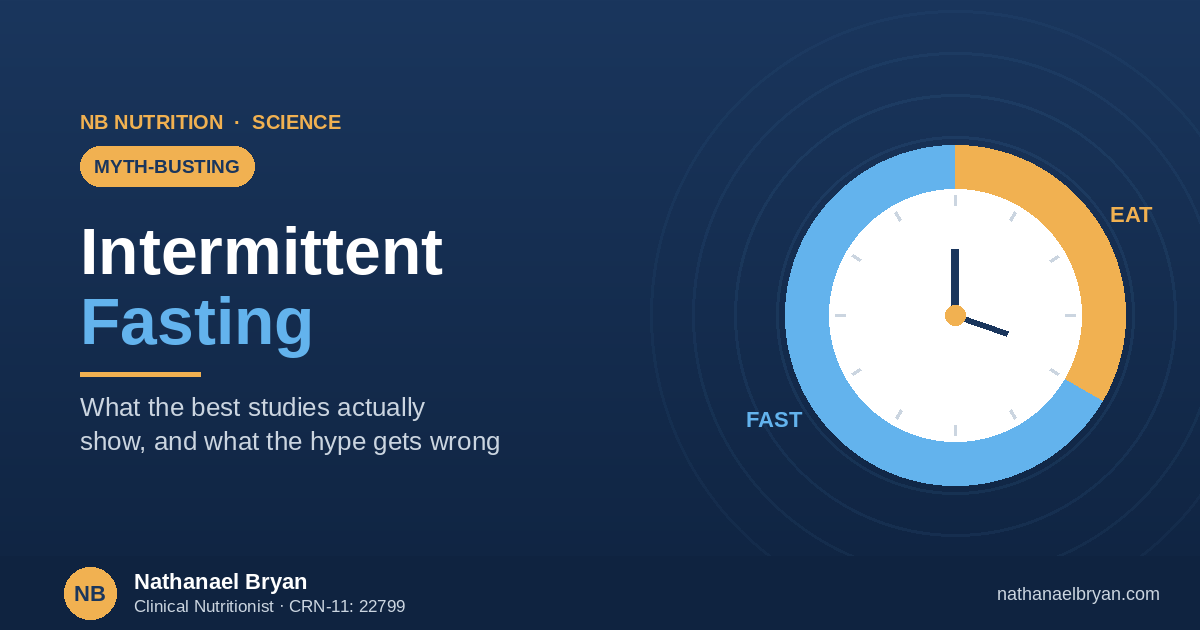
Time-restricted eating means confining all your food to a window each day, often eight hours, fasting the other sixteen. The popular 16:8 protocol is this. Alternate-day fasting and the 5:2 approach are different animals, involving full or near-full fasting on certain days and normal eating on others.
What they all share is simple: they don’t tell you what to eat or explicitly how much. They tell you when. And that single fact is the key to understanding everything the research found.
The claim that gets demolished by the evidence
The central promise of intermittent fasting is that when you eat matters independently of how much. That by squeezing your meals into a window, or fasting on certain days, you unlock fat loss beyond what the same calories would produce on a normal schedule.
This is the exact claim the best study on the topic was designed to test, and the result is worth knowing.
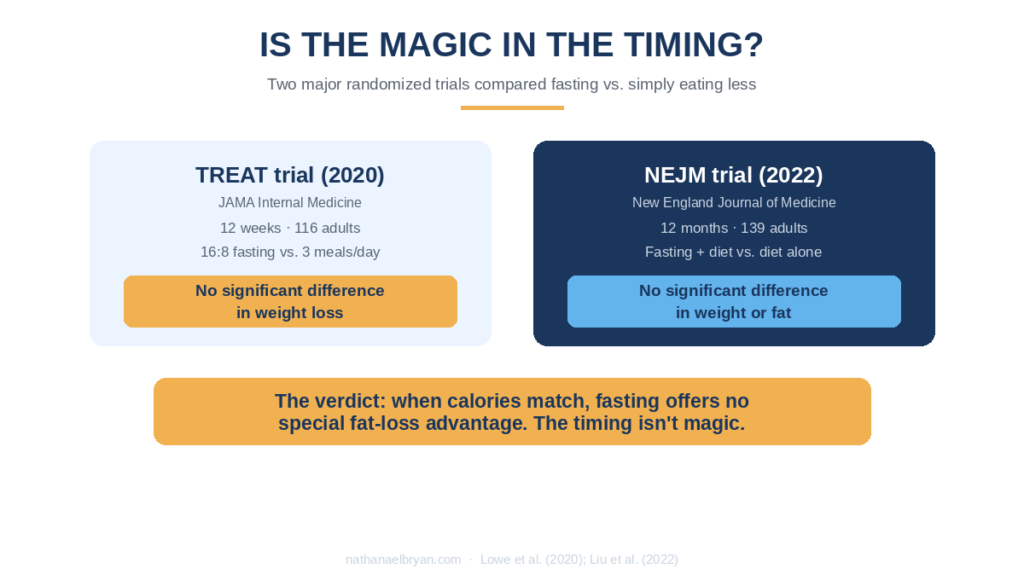
The TREAT trial, led by Lowe and colleagues (2020) and published in JAMA Internal Medicine, was a rigorous twelve-week randomized controlled trial. It took 116 adults with overweight or obesity and split them into two groups. One followed strict 16:8 time-restricted eating, all food between noon and 8 p.m. The other ate three structured meals a day across a normal window. Crucially, both groups received the same weight-loss counseling (LOWE et al., 2020).
The result landed hard against the hype. The time-restricted eating group lost a small amount of weight, but there was no significant difference between the two groups. Eating in a window produced no special advantage over eating across the day (LOWE et al., 2020). The senior author, who had personally practiced and recommended time-restricted eating for years, said he was genuinely surprised by the findings.
And this wasn’t a fluke of a short study. A twelve-month randomized controlled trial published in the New England Journal of Medicine by Liu and colleagues (2022) followed 139 patients with obesity, comparing time-restricted eating plus calorie restriction against calorie restriction alone. After a full year, both groups lost meaningful weight, but there was no significant difference between them in body weight, body fat, or metabolic markers (LIU et al., 2022). The longer, larger study reached the same verdict as TREAT: the magic was never in the timing.
If you’ve read my article on how fat loss actually works, none of this should surprise you. Fat loss is governed by energy balance, by a sustained caloric deficit. The clock on the wall doesn’t repeal that.
So why does intermittent fasting work for some people?
Here’s the part the headlines miss in both directions. Intermittent fasting failing to beat calorie restriction does not mean it’s useless. It means it works through the same mechanism as every other effective approach: it helps some people eat less.
Think about it practically. If you can only eat between noon and 8 p.m., you’ve just eliminated breakfast and late-night snacking. For a lot of people, that naturally cuts a few hundred calories a day without any conscious counting. The fasting window is simply a tool for creating a caloric deficit, and for some people it’s a genuinely useful one.
That’s the honest, evidence-based way to understand it. Intermittent fasting is not a metabolic trick. It’s a scheduling strategy that helps certain people adhere to eating less. If skipping breakfast makes your day easier and your intake lower, it’s a perfectly valid tool. If it makes you ravenous by 2 p.m. and you overeat in your window, it’s the wrong tool for you. Neither outcome has anything to do with magic, and everything to do with whether it helps you sustain a deficit.
This is exactly why I don’t prescribe one rigid method to everyone. The best dietary pattern is the one a specific person can actually maintain. For some that’s intermittent fasting. For others it’s three balanced meals. The science says both work equally well when calories match, so the right answer is whichever one fits your life.
The catch nobody mentions: your muscle
Now the part that genuinely concerns me as a nutritionist, because it’s where intermittent fasting can quietly backfire.
Go back to the TREAT trial and look past the headline. When researchers measured what kind of weight the time-restricted eating group lost, they found something alarming. Of the weight lost, roughly 65% was lean mass, not fat (LOWE et al., 2020). Let that sink in. Most of what these people lost was muscle.
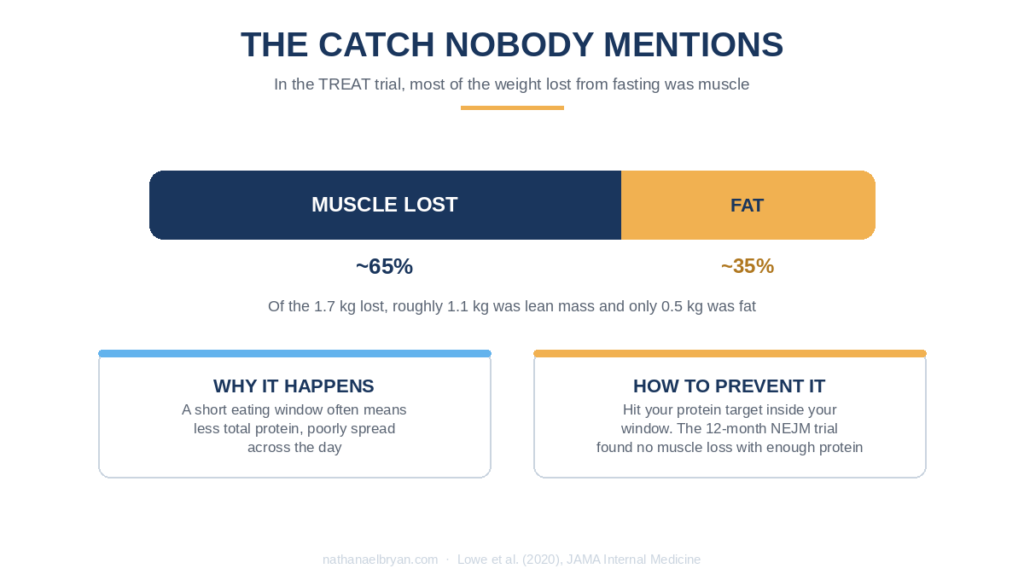
The likely reason is straightforward. When you compress your eating into a short window, two things tend to happen. You often end up eating less protein overall, and you spread it poorly across the day. Both of those work against muscle preservation. The researchers themselves flagged reduced protein intake as a probable culprit and called for more study (LOWE et al., 2020).
This matters enormously, because losing muscle is the opposite of what you want. As I explained in my article on how much protein you actually need, muscle is metabolically precious. Lose it and your metabolism drops, your body looks softer rather than leaner, and you become far more likely to regain the fat later. A diet that strips muscle is a diet quietly sabotaging your long-term results, no matter what the scale says in the short term.
It’s worth noting the picture isn’t uniform. The twelve-month NEJM trial found no significant difference in lean mass between groups, which the authors attributed to adequate protein intake across both diets (LIU et al., 2022). And that’s precisely the point. The muscle loss isn’t an unavoidable curse of fasting. It’s what happens when a fasting window causes you to under-eat protein. Get your protein right, and the risk largely disappears.
What this means for you, practically
Pull it all together and the guidance is refreshingly clear, and a lot more honest than what you’ll hear from someone selling a fasting program.
Intermittent fasting has no metabolic magic. The best randomized trials are consistent: it produces no greater fat loss than simply eating less, when calories are matched. Anyone telling you otherwise is selling a story the evidence doesn’t support.
But it’s a legitimate tool if it suits you. If confining your eating to a window genuinely helps you consume fewer calories without misery, it’s a perfectly good strategy. Use it. Just understand that the window is the means, and the caloric deficit is the actual mechanism.
Protect your protein above all. This is the non-negotiable caveat. If you do practice intermittent fasting, you must be deliberate about hitting your protein target within your eating window, or you risk losing muscle along with fat. The fasting schedule makes adequate protein harder, not easier, so it demands more attention, not less.
And don’t force it. If fasting leaves you starving, irritable, and prone to overeating later, it’s simply not your tool, and you’ve lost nothing by choosing a different approach that works just as well. There is no prize for suffering through a method that doesn’t fit you.
The deeper lesson here is the one that runs through everything I teach. Strip away the marketing and the mechanism is always the same: a sustainable caloric deficit, enough protein, and a pattern you can actually live with. Intermittent fasting can serve that goal for some people. It cannot replace it for anyone.
If you want help figuring out whether intermittent fasting fits your life, or building any sustainable approach around your real schedule and goals, that’s the work I do with my patients, individualized and adjusted over time rather than forced from a template. You can see how my coaching works here. If you’d rather start by learning the fundamentals yourself, my educational materials are here, and you can estimate your own numbers with my free calculator.
References
LIU, D.; HUANG, Y.; HUANG, C. et al. Calorie restriction with or without time-restricted eating in weight loss. New England Journal of Medicine, v. 386, n. 16, p. 1495–1504, 2022. Available at: https://www.nejm.org/doi/full/10.1056/NEJMoa2114833. Accessed: 16 jun. 2026.
LOWE, D. A.; WU, N.; ROHDIN-BIBBY, L. et al. Effects of time-restricted eating on weight loss and other metabolic parameters in women and men with overweight and obesity: the TREAT randomized clinical trial. JAMA Internal Medicine, v. 180, n. 11, p. 1491–1499, 2020. Available at: https://jamanetwork.com/journals/jamainternalmedicine/fullarticle/2771095. Accessed: 16 jun. 2026.
OSTENDORF, D. M.; CALDWELL, A. E.; ZAMAN, A. et al. Comparison of weight loss induced by daily caloric restriction versus intermittent fasting (DRIFT) in individuals with obesity: study protocol for a 52-week randomized clinical trial. Trials, v. 23, n. 1, p. 718, 2022. Available at: https://pmc.ncbi.nlm.nih.gov/articles/PMC9421629/. Accessed: 16 jun. 2026.
PATTERSON, R. E.; SEARS, D. D. Metabolic effects of intermittent fasting. Annual Review of Nutrition, v. 37, p. 371–393, 2017. Available at: https://pubmed.ncbi.nlm.nih.gov/28715993/. Accessed: 16 jun. 2026.