Let me guess. You’ve tried cutting carbs. Maybe keto. Maybe intermittent fasting, or that detox your coworker swears by. You lost some weight, gained it back, and now you’re wondering if your metabolism is broken or if you’re just doing something wrong.
Here’s the truth: you were never taught how fat loss actually works. Not by your doctor, not by fitness influencers, and definitely not by the diet industry. An informed person is a terrible customer.
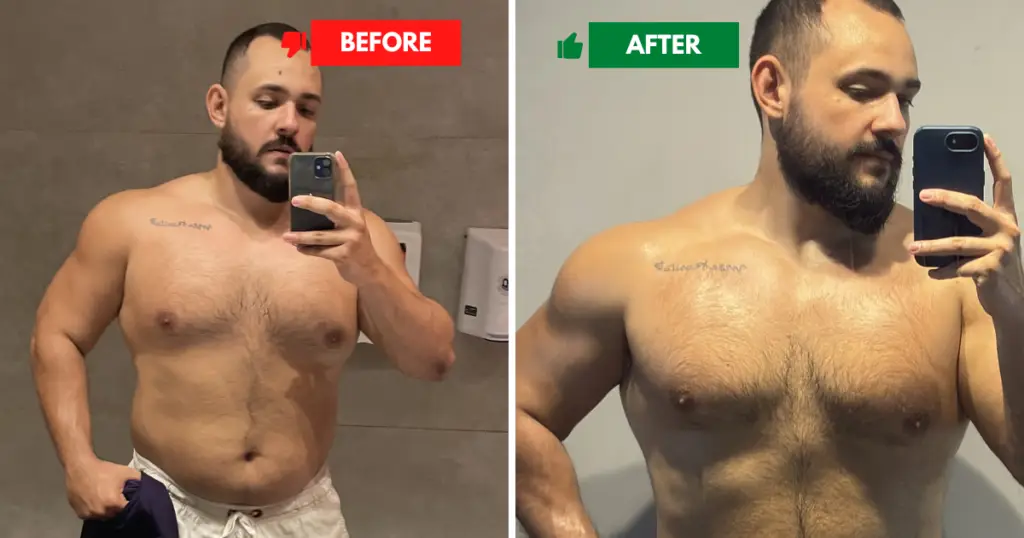
I know this from both sides. I was obese. I tried every extreme diet you can name. I saw five different nutritionists and seven endocrinologists, and none of them solved my problem. So I left my Engineering and Physics studies and learned the science myself and lost over 85 pounds without steroids, without shortcuts, and without giving up the foods I love.
This article is the foundation I wish someone had given me on day one. Let’s get into i
Weight Loss vs. Fat Loss: They’re Not the Same Thing
Your body weight is the sum of everything you’re made of: organs, muscle, bone, water and yes, fat. When the scale moves, it doesn’t tell you what changed. It just tells you that something did.
Here’s a dramatic example: MMA fighters routinely drop 15–20 pounds in a single week before weigh-ins. Are they losing fat? Absolutely not. They’re dehydrating themselves through saunas, water manipulation, and diuretics. Within 24 hours of the weigh-in, almost all of it is back.
That’s weight loss: a change in total body mass, regardless of what was lost.
Fat loss is something different: reducing your body’s fat mass specifically, while preserving (or even building) your muscle mass. And that should be your real goal, for two reasons:
- Muscle is metabolically protective. It keeps your metabolism higher, your body functional, and your results sustainable.
- Fat loss is what changes your health and your appearance. Nobody actually wants to “weigh less”; they want less body fat. The scale is just a (flawed) proxy for that.
This distinction matters enormously if you’re using medications like Ozempic or Mounjaro, by the way and we’ll get to that.
The One Law That Governs All Fat Loss
Everything in the universe (including your body!) obeys the laws of thermodynamics. Energy cannot be created or destroyed. It can only be transferred or transformed.
Your body needs energy constantly: to keep your heart beating, your brain thinking, your lungs breathing, your cells repairing. That energy comes from one place: the food you eat.
Now, every single day, one of three things happens:
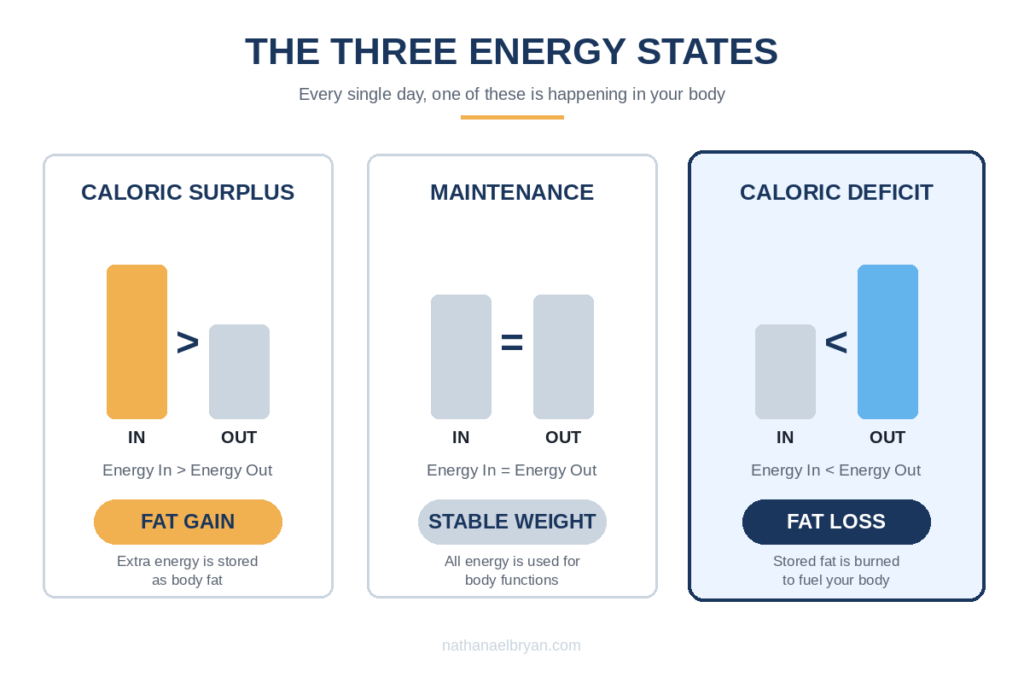
The Three Energy States
1. You eat more energy than your body uses (caloric surplus). Your body takes the extra energy and stores it primarily as body fat. This is how fat gain happens. Not because of carbs. Not because of insulin. Because of surplus energy.
2. You eat exactly what your body uses (maintenance). All incoming energy is used for body functions. Your weight and body composition stay stable.
3. You eat less energy than your body uses (caloric deficit). Your body still needs to keep you alive so it turns to its stored energy reserves. It opens up your fat cells and burns the fat inside for fuel. This is fat loss. This is the only way fat loss happens.
There is no diet, no medication, no supplement, and no training program on Earth that produces fat loss without a caloric deficit. Keto works when it creates a deficit. Fasting works when it creates a deficit. Ozempic works when it creates a deficit. The deficit is always the mechanism. Everything else is just a different road to the same destination.
“Burning Fat” Is Not the Same as Losing Fat
This is one of the most misunderstood concepts in all of fitness and understanding it will protect you from an enormous amount of marketing nonsense.
Fat burning happens whenever your body needs energy and there isn’t immediate fuel available. Do fasted cardio in the morning? Yes, you’ll burn fat during that session.
Fat loss only happens when your total energy balance across the day (and week, and month) is negative.
Here’s the catch: if you burn fat during your morning workout but eat in a surplus for the rest of the day, your body simply refills the fat you burned and possibly adds more. You burned fat. You lost nothing.
This is why “fat-burning workouts,” “fat-burning zones,” and “fat-burning supplements” are mostly marketing. The question is never “did I burn fat during this activity?” The question is “is my total energy balance negative?”
Why Your Body Fights Back
If fat loss is just “eat less than you burn,” why is it so hard?
Because your body doesn’t know you live in 2026 with a supermarket on every corner. Evolutionarily, body fat meant survival. Our ancestors faced real food scarcity and the bodies that stored fat efficiently and defended it fiercely were the ones that survived to pass on their genes.
Your body inherited that programming. So when you start losing fat, it activates defense mechanisms:
- Your metabolism slows down. Research shows that for every kilogram (2.2 lbs) of fat you lose, your daily energy expenditure drops by roughly 40 calories beyond what the weight loss alone would predict. This is called adaptive thermogenesis.
- Your hunger increases. That same kilogram of lost fat increases your hunger signals by approximately 100 calories per day. Your body is literally trying to talk you into eating the fat back.
- You move less without noticing. Your NEAT (non-exercise activity thermogenesis, all the walking, fidgeting, and standing you do) silently decreases. You burn fewer calories without making a single conscious decision.
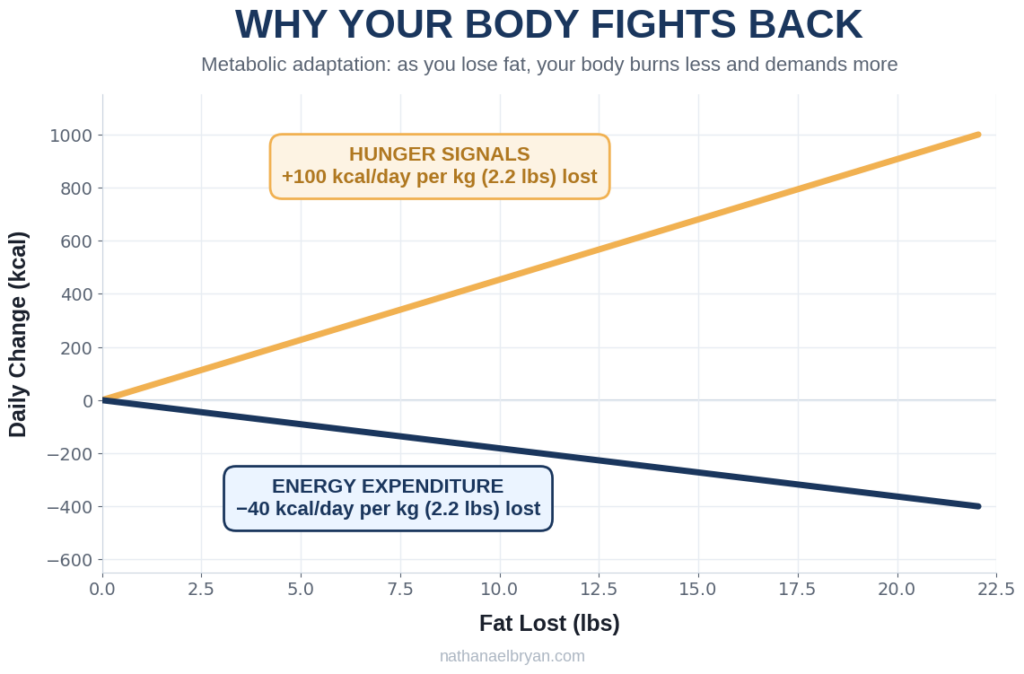
This is why people “stall.” This is why the rebound effect exists. It’s not weakness. It’s not a broken metabolism. It’s biology doing exactly what it evolved to do and it’s also why structured, long-term strategies beat aggressive short-term diets every single time.
“I’m Eating in a Deficit But Not Losing Weight” — The Hard Truth
I hear this constantly. And I say this with all the empathy of someone who’s been on the other side of this conversation:
If you are not losing fat over time, you are not in a caloric deficit. Period.
The laws of thermodynamics govern every system in the universe. They do not make an exception for you. So what’s actually happening? Almost always one of two things:
- You’re underestimating how much you eat. Studies consistently show people underreport their caloric intake sometimes by up to 50%. The bites, the sauces, the cooking oil, the weekend “exceptions”… they all count.
- You’re overestimating how much you burn. That spin class didn’t burn 800 calories. Your fitness tracker is optimistic. Your activity level is probably “lightly active,” not “very active.”
And if you lost weight before and then stalled? Remember adaptive thermogenesis; your body now burns fewer calories than it did 15 pounds ago. The deficit that worked before may simply be a maintenance intake now. The solution isn’t to give up. It’s to recalculate and adjust, something I do with my patients every few weeks.
What About Ozempic and Mounjaro?
You’ve heard the claim: maybe you’ve even said it:
“I was dieting and not losing weight, but now on Mounjaro I’m finally losing!”
Now that you understand energy balance, you can see the logical error in this sentence. If you weren’t losing fat before, you weren’t in a deficit before despite what you believed. The medication didn’t change the laws of physics. It changed your appetite.
GLP-1 medications (Ozempic, Wegovy, Mounjaro, Zepbound) are genuinely remarkable tools. They reduce hunger, quiet the constant “food noise” in your brain, and slow down your stomach’s emptying. The result? You spontaneously eat less and finally achieve the caloric deficit you couldn’t sustain before.
The medication didn’t burn your fat. The deficit did. The medication just made the deficit achievable.
This is also exactly why so many people regain everything within 1–2 years of stopping these medications: the appetite suppression disappears, but the eating habits, the nutritional knowledge, and the behavioral foundation were never built. The medication was doing all the work and then it left.
(GLP-1 medications deserve their own deep dive that article is coming soon.)
The Real Challenge Isn’t Knowledge. It’s Adherence.
Here’s the part most articles won’t tell you, because it’s harder to sell than a 30-day miracle:
A “perfect” diet you can’t stick to produces nothing. An imperfect diet you follow consistently produces transformation.
We live in what scientists call an obesogenic environment: a world engineered to make you gain fat. Hyper-palatable, calorie-dense food is available 24/7. Our jobs keep us sitting. Our screens keep us sedentary. Stress and poor sleep amplify our hunger hormones.
Fat loss means swimming against this current; and that’s precisely why sustainable beats extreme, every time. Yes, you can lose fat eating pizza and ice cream occasionally, as long as your energy balance is negative. More importantly: a plan that includes the foods you love is a plan you can follow for years, not weeks.
The goal was never “lose 30 pounds in 90 days and then go back to normal.” The goal is to change what normal looks like. Gradually, sustainably, and without sacrificing your social life or your sanity.
Where to Start?
If you’ve read this far, you already understand fat loss better than most people who’ve been dieting for a decade. Here’s how to put it into action:
Step 1: Calculate your energy expenditure. You can’t create a deficit if you don’t know your maintenance level. I built a free calculator that estimates your daily energy needs and body fat percentage (use it here.)
Step 2: Create a moderate deficit. Start with 300–500 calories below maintenance. Aggressive deficits accelerate muscle loss and trigger stronger metabolic adaptation. This is a long game.
Step 3: Prioritize protein and strength training. They’re your two best tools for making sure the weight you lose is fat, not muscle. (Full articles on both coming soon.)
Step 4: Get support if you need it. Knowledge is the foundation, but individualized strategy, accountability, and weekly adjustments are what turn knowledge into results. That’s exactly what I do with my patients, week after week, until they don’t need me anymore. If you want to do this right, learn how my nutrition coaching works.
Frequently Asked Questions
Can you lose fat without counting calories?
Yes. Counting calories is a tool, not a requirement. What’s non-negotiable is the caloric deficit itself. Many people achieve it through portion control, food choices, and structured eating patterns without tracking numbers. Tracking is simply the most precise way to calibrate, especially at the start.
Why am I losing weight but looking the same?
You may be losing muscle and water alongside (or instead of) fat, especially if your protein intake is low and you’re not strength training. This is also common with rapid weight loss on GLP-1 medications without nutritional support. Focus on fat loss, not weight loss.
How fast should I lose fat?
A sustainable pace for most people is 0.5–1% of body weight per week. Faster than that significantly increases muscle loss and metabolic adaptation, making the result harder to maintain.
Do carbs make you fat?
No. A caloric surplus makes you fat. Carbohydrates are simply one source of calories and for most people, they’re a valuable one for training performance, satiety, and quality of life. Every diet that “eliminates carbs” works through the same mechanism as every other diet: the caloric deficit.
Is my metabolism broken?
Almost certainly not. True metabolic disorders are rare and diagnosable. What you’re likely experiencing is adaptive thermogenesis (a normal response to dieting), underestimated food intake, or both. The good news: both are fixable with the right strategy.

One Response