If there’s one nutrition question I get more than any other, it’s this one. And it makes sense, because protein is having a moment. Walk through any grocery store and you’ll see protein bars, protein cereal, protein water, protein coffee. The whole industry figured out that slapping “high protein” on a label sells.
The funny thing is that for once, the trend is actually pointing in the right direction. Protein really is that important for fat loss. But the marketing has muddied the water so badly that most people have no idea how much they actually need, where it should come from, or why it matters in the first place.
So let’s clear it up. No hype, no supplement pitch. Just what the science says and how to apply it.
Why protein matters more than any other macro for fat loss
When you’re trying to lose fat, you’re eating less than your body needs. That’s the whole game, a caloric deficit sustained over time. I covered the full mechanism in my article on how fat loss actually works, but here’s the part that matters for this conversation.
When you put your body in a deficit, it goes looking for energy. Ideally it pulls that energy from your fat stores, which is exactly what you want. The problem is that your body doesn’t only burn fat. If you’re not careful, it’ll break down muscle for energy too. And losing muscle is bad news on every front.
Protein is what prevents that. It’s the signal and the raw material your body uses to hold onto muscle while it sheds fat. Get enough of it and the weight you lose comes mostly from fat. Skimp on it and a real chunk of that weight comes off your muscle instead, which is the last thing you want.
There are three reasons protein earns its reputation, and they’re worth understanding.
It protects your muscle. This is the big one. In a deficit, adequate protein tells your body to keep its muscle and burn fat instead. Lose muscle and your metabolism drops, your body looks softer rather than leaner even as the scale moves, and you become more likely to regain everything later.
It keeps you full. Of the three macronutrients, protein is by far the most satiating. It does this partly by raising your satiety hormones, the same GLP-1 and PYY that the weight loss medications target, and by lowering ghrelin, your hunger hormone. In plain terms, a high-protein meal keeps you satisfied longer, which makes sticking to a deficit a lot easier.
It costs energy to digest. Your body burns roughly 25 to 30 percent of the calories in protein just breaking it down, far more than it spends on carbs or fat. So a portion of the protein you eat essentially pays for its own digestion. It’s a small effect, but it’s real, and it tilts things in your favor.
So how much do you actually need?
Here’s where most people get it wrong, and where I want to be precise.
You’ve probably seen the official RDA of 0.8 grams per kilogram of body weight. Forget that number for fat loss. The RDA is the bare minimum to keep a sedentary person from becoming deficient. It was never meant to describe what’s optimal, especially not for someone in a caloric deficit trying to hold onto muscle.
For fat loss, the research points to a much higher target:
1.6 to 2.2 grams per kilogram of body weight per day. In pounds, that lands somewhere around 0.7 to 1 gram per pound. For a 180-pound person, that’s roughly 130 to 180 grams of protein a day.
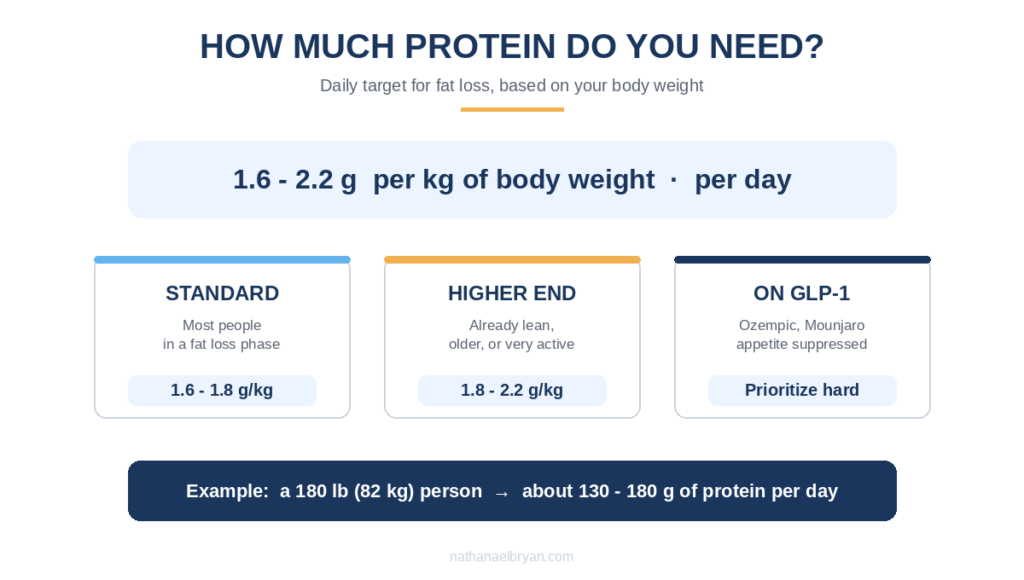
A few situations call for the higher end of that range, or even above it:
If you’re leaner already and trying to get even leaner, your body leans more on protein for fuel, so you want to push toward the top of the range to protect what muscle you have.
If you’re older, your body becomes less efficient at using protein to build and maintain muscle, a problem called anabolic resistance. Adults over 60 generally benefit from staying at the higher end, around 1.8 to 2.4 grams per kilogram.
If you’re on a GLP-1 medication like Ozempic or Mounjaro, this becomes critical. These drugs suppress your appetite so effectively that hitting your protein target by accident is nearly impossible. As I explained in my article on what these medications actually do, without deliberate protein intake, a large share of the weight you lose can come from muscle. If that’s you, protein isn’t optional. It’s the thing that decides whether you come out of this leaner and stronger or just smaller and weaker.
One more point that trips people up. Notice these targets are tied to your body weight, not to a percentage of your calories. “Get 30 percent of your calories from protein” sounds scientific but it’s a poor way to plan, because it shifts around depending on how much you’re eating. Grams per kilogram gives you an absolute target you can actually hit. This is exactly why I never use fixed percentages with my patients. We work in real grams, tailored to the individual.
When you eat it matters too
Total daily protein is what matters most, by a wide margin. If you only take one thing from this article, make it the daily target. But once you’ve got that locked in, how you distribute it through the day gives you a little extra edge.
Your body can only use so much protein for muscle building at one sitting. Spreading your intake across three to five meals, with somewhere around 30 to 50 grams each, keeps muscle protein synthesis topped up throughout the day. This matters more as you get older, and it matters a lot if you’re eating less overall on a medication.
The practical version: instead of a tiny breakfast, a sandwich at lunch, and a giant steak at dinner, aim to get a solid hit of protein at every meal. Eggs in the morning, real protein at lunch, real protein at dinner. It’s a simple change that pays off.
Where your protein should come from
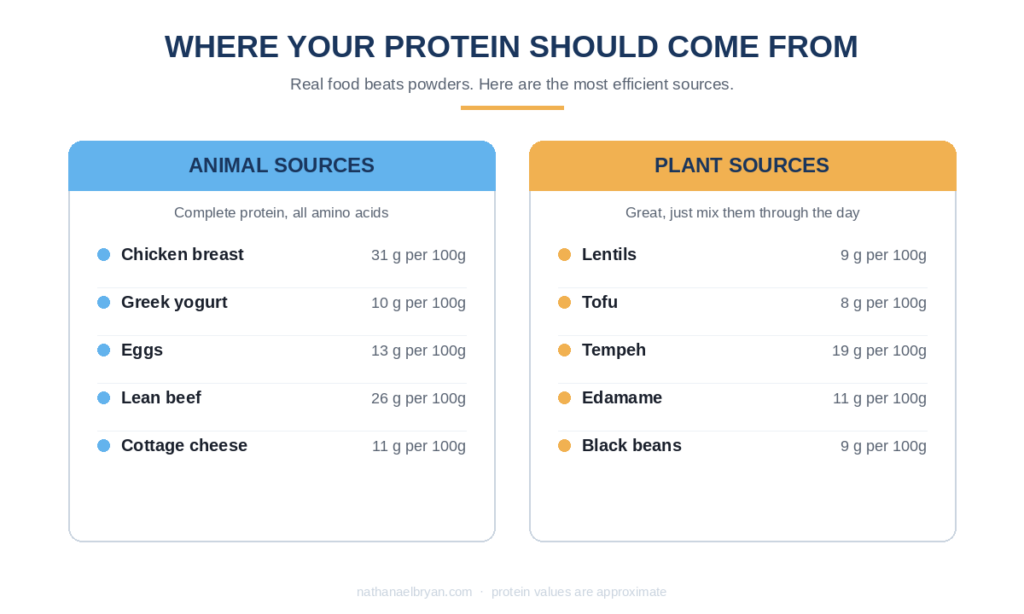
You don’t need powders or special products to hit your target. Real food does the job better. Here’s what actually moves the needle.
Animal sources give you complete protein, meaning all the amino acids your body needs in the right ratios. Chicken, fish, lean beef, eggs, Greek yogurt, and cottage cheese are some of the most efficient options out there. Greek yogurt and cottage cheese in particular are easy ways to add protein without much cooking.
Plant sources can absolutely work, they just need a bit more thought. Lentils, beans, tofu, tempeh, and edamame are solid choices. Plant proteins are generally less concentrated and lower in leucine, the amino acid that triggers muscle building, so if you’re eating mostly plants you’ll want to eat a bit more of them and mix sources across the day to cover all your bases.
Protein powder is fine, but think of it as a convenience, not a requirement. If you’re struggling to hit your number through food, a scoop of whey or a plant blend makes it easier. That’s the whole value, convenience. There’s nothing magic in the tub that you can’t get from chicken and yogurt.
A few protein myths worth killing
“Too much protein wrecks your kidneys.” This one refuses to die. In people with healthy kidneys, there’s no good evidence that high protein intake causes damage. The concern is real only for those who already have kidney disease. For a healthy adult, the protein levels we’re talking about here are safe.
“I already get plenty of protein.” Most people don’t, and women especially tend to fall short. When I actually have patients track their intake for a few days, the number is almost always lower than they guessed. It’s worth checking rather than assuming.
“You can only absorb 30 grams of protein per meal.” Half-true and often misunderstood. Your body absorbs all the protein you eat. What’s capped is how much it can use for muscle building in one go, which is why spreading intake helps. But a 60-gram meal isn’t wasted, so don’t stress if one of your meals runs big.
How to actually put this to work
You don’t need to overhaul your life. Start here.
Work out your target first. Take your body weight in kilograms and multiply by something in the 1.6 to 2.2 range. If you think in pounds, aim for roughly 0.7 to 1 gram per pound. That’s your daily number.
For a week or two, actually track it. Most people are surprised how far off their guess was. You don’t have to track forever, just long enough to learn what your meals really contain and to build the habit of putting protein at the center of the plate.
Then build each meal around a protein source and fill in the rest. Pick your protein first, then add your carbs, vegetables, and fats around it. Do that three to five times a day and the daily target mostly takes care of itself.
That’s genuinely most of it. Protein isn’t complicated once you cut through the marketing. Hit your number, spread it out, lean on real food, and you’ve handled the single most important piece of eating for fat loss.
If you want help building this into a full plan that fits your life, your schedule, and your goals, that’s exactly what I do with my patients. We don’t use cookie-cutter meal plans or rigid formulas. We build something you can actually live with, and we adjust it as often as needed. You can see how my coaching works here.
Frequently Asked Questions
How much protein do I need to lose fat?
For most people in a fat loss phase, aim for 1.6 to 2.2 grams of protein per kilogram of body weight per day, which is roughly 0.7 to 1 gram per pound. Go toward the higher end if you’re already lean, older, or using a GLP-1 medication.
Is too much protein bad for you?
For people with healthy kidneys, the protein intakes recommended for fat loss are safe and not linked to kidney damage. The kidney concern applies to those who already have kidney disease. If that’s your situation, talk to your doctor before raising your intake.
Can I get enough protein without supplements?
Yes. Whole foods like chicken, fish, eggs, Greek yogurt, cottage cheese, lentils, and tofu can easily cover your needs. Protein powder is a convenience for hitting your target more easily, not a requirement.
How much protein should I eat per meal?
Spreading your protein across three to five meals, with about 30 to 50 grams each, helps your body use it most effectively for maintaining muscle. This matters more as you age and if you’re eating less overall.
Why do I need more protein on Ozempic or Mounjaro?
These medications suppress appetite so strongly that it’s easy to eat too little protein, which leads to losing muscle along with fat. Prioritizing protein, along with resistance training, protects your muscle and keeps your metabolism healthier while you lose weight.
Does protein really help with hunger?
Yes. Protein is the most filling of the three macronutrients. It raises satiety hormones and lowers ghrelin, your main hunger hormone, which makes it easier to stay in a caloric deficit without feeling miserable.