You’re doing everything right. You’re eating less, you’re tracking your food, maybe you’re hitting the gym a few times a week. And the scale just sits there, mocking you. Week after week, nothing.
I get it. I’ve been there myself, back when I was obese and convinced my body was broken in some special way that no diet could touch. So I want to give you a straight answer, even though it’s not the answer most articles will give you. Most of them will list ten gentle possibilities and tiptoe around the real one because the real one is uncomfortable.
Here it is. If you are genuinely not losing fat over time, you are not actually in a calorie deficit. That’s it. That’s the answer.
Now before you close the tab, stick with me, because that sentence sounds harsh and it isn’t meant to be. It’s actually good news, and once you understand why, it hands you back control. Let me explain what’s really happening.
The part nobody wants to hear
The first law of thermodynamics governs your body the same way it governs a car engine or a star. Energy can’t be created or destroyed. If you’re consistently taking in less energy than you burn, your body has no choice but to pull the difference from storage, and that storage is your body fat. I walked through this whole mechanism in my article on how fat loss actually works, and it’s worth a read if you haven’t.
The point is this. Your body is not exempt from physics. There is no metabolic condition that lets you store fat from calories that don’t exist. So when someone tells me they’re eating 1,400 calories a day and not losing an ounce, I don’t think they’re lying. I think they’re missing something. And almost always, it falls into one of the buckets below.
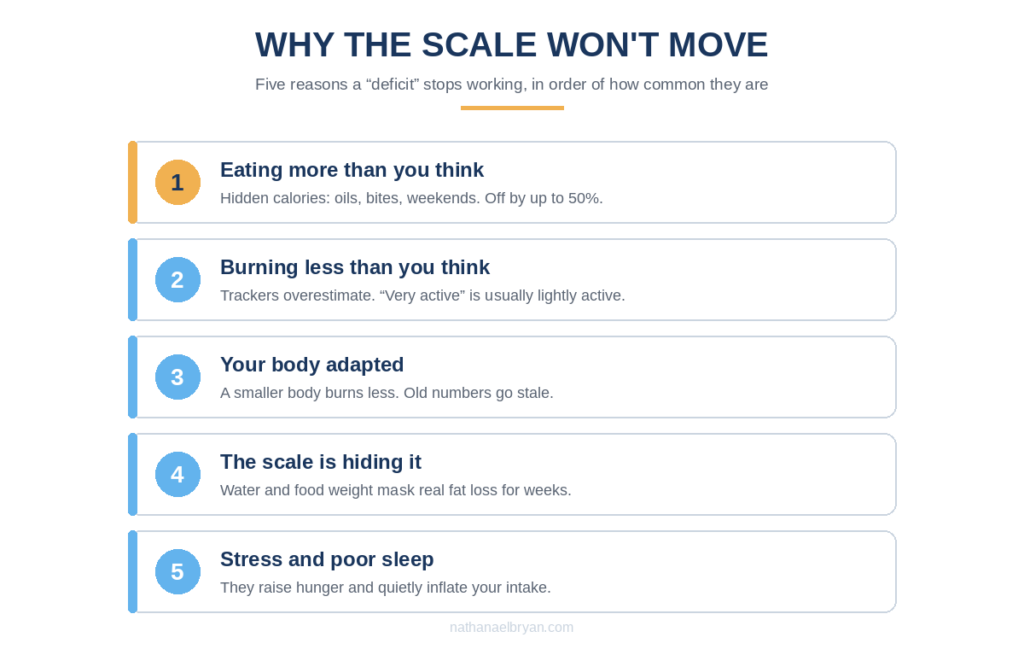
The reason this is good news is simple. A broken metabolism would be out of your hands. A measurement gap is something you can find and fix.
Reason one: you’re eating more than you think
This is the big one, and it’s responsible for the majority of stalls I see. Study after study shows that people underestimate how much they eat, sometimes by as much as 50 percent. And these aren’t careless people. They’re often the ones who feel like they’re being strict.
Here’s where the hidden calories hide. The splash of olive oil you cook with, which can be 120 calories a tablespoon and most people pour two or three without thinking. The handful of nuts. The bites while cooking. The kid’s leftovers you finished standing over the sink. The “just a taste” of something five times a day. The weekend that quietly undoes the whole week. None of it feels like eating, but your body counts every calorie whether you logged it or not.
The fix isn’t to obsess. It’s to get honest for a short while. Weigh your food with a kitchen scale for one or two weeks, not forever, just long enough to recalibrate your sense of portions. Almost everyone who does this discovers their “small” portions were double what they assumed. Once you see it, you can’t unsee it, and that alone often breaks the stall.
Reason two: you’re burning less than you think
The other side of the equation. You might be overestimating how much you burn, which inflates the deficit you believe you have.
That fitness watch telling you that you torched 700 calories on a run? Treat it as optimistic. These devices are notoriously inaccurate for calorie burn, often off by 30 percent or more. The cardio machine at the gym is no better. So if you’re “eating back” the calories your tracker says you burned, you might be eating back calories you never actually spent, erasing your deficit completely.
And your daily activity level is probably lower than the category you picked. Most people who call themselves “very active” are, in calorie terms, lightly active. A few gym sessions a week don’t move you into the high-burn tier if the rest of your day is spent sitting.
Reason three: your body adapted, and your old numbers are stale
This one is real, and it’s where a lot of people get genuinely stuck through no fault of their own.
When you lose weight, your body gets smaller, and a smaller body burns fewer calories. On top of that, your body actively fights the loss through something called metabolic adaptation. It quietly turns down your energy expenditure beyond what the weight loss alone would predict. It does this by lowering the calories you burn at rest and, sneakily, by reducing your NEAT, the energy you spend on all the little movements you don’t think about, like fidgeting, walking, even standing.
So the deficit that was working three months ago might not be a deficit anymore. The 2,000 calories that once stripped fat off you could now be your exact maintenance level, because the person doing the eating is 20 pounds lighter and running a more economical metabolism.
This isn’t a sign of failure. It’s expected, and it’s predictable. The fix is to recalculate. Every four to six weeks, as your weight changes, your numbers need to change with it. This is one of the things I do constantly with my patients, because a plan that doesn’t adjust stops working by design.
Reason four: the scale is lying about your progress
Sometimes you actually are losing fat, and the scale just refuses to show it. This trips people up more than almost anything.
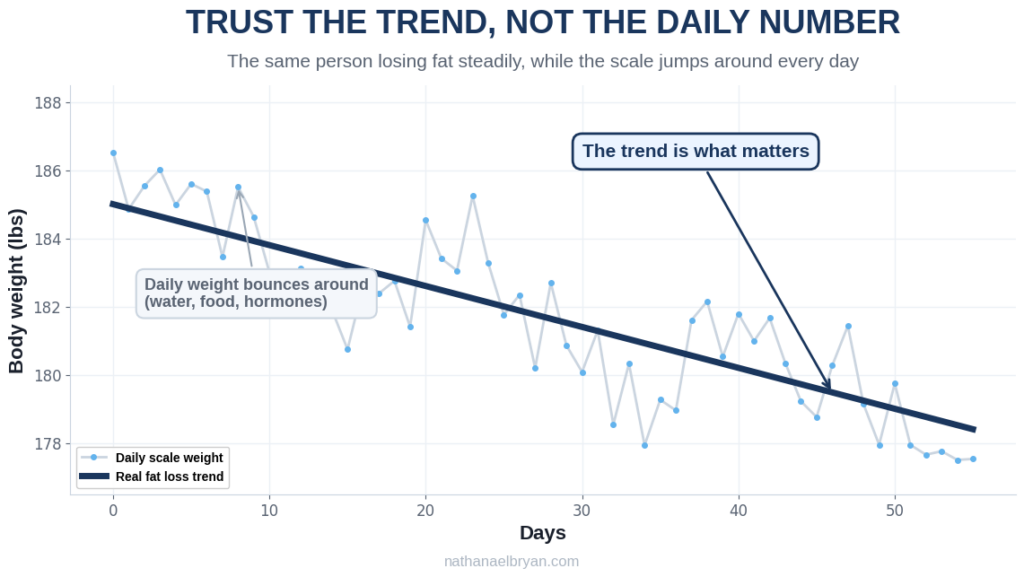
Your body weight swings two to five pounds day to day for reasons that have nothing to do with fat. Water retention from a salty meal. Hormonal shifts, especially around the menstrual cycle. The actual food sitting in your digestive system. Water your muscles hold while repairing after a workout. None of that is fat, but all of it shows up on the scale and can completely mask real fat loss for a week or two.
So if you’ve lost fat but the scale hasn’t moved, you might be retaining water over the same period, hiding the change. The answer is to stop trusting a single daily number. Look at the trend over two to four weeks, not day to day. And weigh your progress with more than the scale: how your clothes fit, photos, body measurements, your energy and strength in the gym. These often shift before the scale catches up.
Reason five: stress and sleep are quietly working against you
These don’t break the laws of physics, but they make the deficit much harder to actually maintain, which amounts to the same thing.
When you’re chronically stressed, your cortisol stays elevated, and that drives up appetite, especially for high-calorie comfort food. It also makes it easier to store visceral fat. You end up fighting your own biology to stick to the plan.
Sleep might matter even more. Skimp on it, under seven hours, and your hunger hormones tilt against you. Ghrelin rises, leptin falls, and studies show poorly rested people eat a few hundred extra calories the next day without realizing it. Poor sleep also drains the willpower you need to make good food choices. So you don’t necessarily have a metabolism problem. You might have a sleep problem that’s silently inflating your intake.
So what do you actually do about it?
Work through it in order. Most stalls resolve once you find the real cause.
Start by tightening your tracking for a week or two. Weigh your food, log everything including the oils and the bites, and be ruthlessly honest. This alone solves most cases, because most cases are hidden calories.
Stop eating back your exercise calories, or at most eat back half. Don’t trust the tracker’s burn number.
If your tracking is genuinely tight and you’ve been dieting for a while, recalculate your targets for your current body weight. Your old numbers are probably stale.
Zoom out on your progress. Judge it over weeks, using measurements and photos, not just the daily scale weight.
And protect your sleep and manage your stress like they’re part of the diet, because they are.
Here’s the encouraging truth underneath all of this. If you’re not losing fat, it’s not because your body is uniquely broken or because the rules don’t apply to you. It’s because there’s a gap somewhere between what you think is happening and what’s actually happening. Gaps can be found. Gaps can be closed. That puts you back in the driver’s seat.
If you’ve worked through all of this and you’re still stuck, or you just don’t want to play detective on your own, that’s exactly what I help my patients with. We find the gap, fix it, and adjust the plan as your body changes, week by week, until it’s actually working. You can see how my coaching works here.
Frequently Asked Questions
Why am I not losing weight in a calorie deficit?
If you’re genuinely not losing fat over time, you’re most likely not in an actual deficit, even if it feels like you are. The usual culprits are underestimating how much you eat, overestimating how much you burn, or relying on a deficit that’s gone stale as your body adapted. Less commonly, the scale is hiding real fat loss behind water weight.
Can a slow metabolism stop you from losing weight?
True metabolic disorders are rare and diagnosable by a doctor. What most people experience is metabolic adaptation, a normal slowdown in calorie burn as you lose weight. It doesn’t make fat loss impossible, it just means your targets need to be recalculated as you go.
How long should I stay in a calorie deficit before I see results?
Fat loss shows up over weeks, not days. Daily weight swings from water and food can hide real progress for a week or two. Judge your progress over a two-to-four-week trend, and use measurements and photos alongside the scale.
Does stress really stop weight loss?
Stress doesn’t override physics, but it makes a deficit much harder to maintain. Elevated cortisol raises appetite and cravings, and chronic stress is linked to more visceral fat storage. Managing it makes sticking to your plan far easier.
Why is the scale not moving even though I look leaner?
You’re likely losing fat while your body holds onto water, which masks the change on the scale. You might also be gaining a little muscle while losing fat, a process called body recomposition. This is why measurements, photos, and how your clothes fit are better progress markers than scale weight alone.
Should I eat back the calories I burn from exercise?
Generally no, or at most half of them. Fitness trackers and cardio machines tend to overestimate calorie burn significantly. Eating back inflated exercise calories is one of the most common ways people accidentally erase their deficit.