You can have your calories dialed in, your protein on point, and your training consistent, and still feel like fat loss is harder than it should be. When that happens, there’s a variable most people never think to check: how much they’re sleeping.
It sounds almost too simple. Sleep more, lose fat easier? But this is one of the few areas in nutrition where the evidence is genuinely strong, built on controlled experiments rather than guru opinion. So let’s go through what the research actually shows, where it’s solid, and where it’s messier than the headlines suggest. Because the honest version is more useful than the oversimplified one.
The core finding: short sleep makes you eat more
Start with the question that matters most. Does sleeping less actually make people eat more? The controlled data says yes, fairly consistently.
In one of the largest laboratory studies on this, Spaeth and colleagues (2013) put 225 healthy adults through controlled sleep conditions and measured what happened. The sleep-restricted group, held to four hours in bed per night, gained more weight than the control group over just a few nights, and the mechanism was clear: they ate more, and a large share of those extra calories came late at night, after 10 p.m. (SPAETH; DINGES; GOEL, 2013). This wasn’t a small or vague effect. Restricted sleepers consumed well over 500 extra calories during the late-night window that well-rested people simply weren’t awake to eat.
That late-night piece matters more than it first appears, and we’ll come back to it.
A separate randomized crossover trial by St-Onge and colleagues (2011) found much the same thing using a different design. When the same people were studied under both short sleep and normal sleep, they ate noticeably more during the short-sleep phase, while the amount of energy they burned didn’t meaningfully change (ST-ONGE et al., 2011). That last detail is important. The problem isn’t that short sleep slows your metabolism in some dramatic way. The problem is the intake side. You eat more, you don’t burn meaningfully more, and the gap lands on your waistline.
The strongest evidence: what happens when you sleep more
Showing that less sleep makes people eat more is useful, but it leaves the practical question unanswered. If someone who’s already sleep-deprived starts sleeping more, do they eat less? That’s the question that actually matters for fat loss, and it’s where the best study in this whole area comes in.
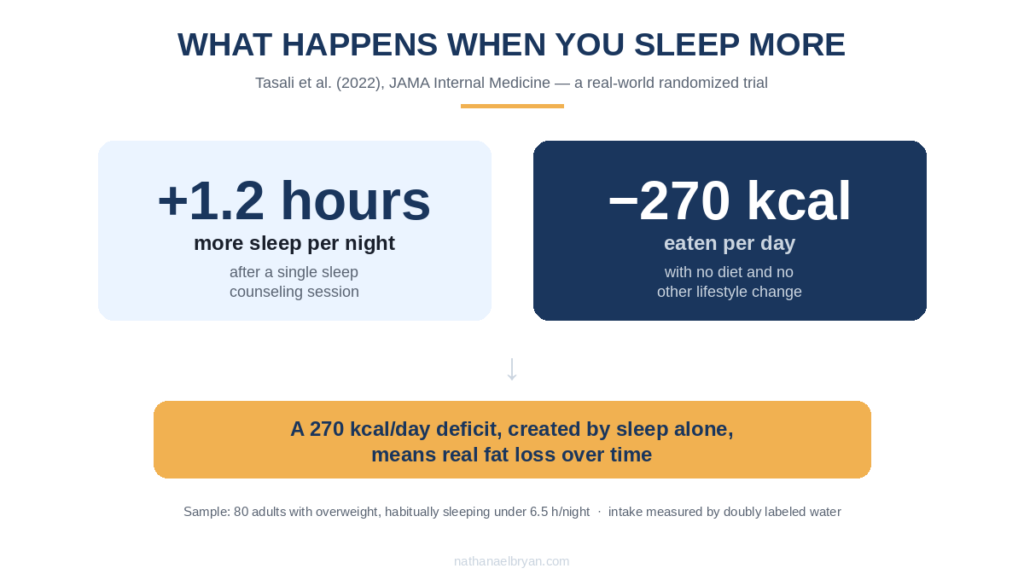
Tasali and colleagues (2022), publishing in JAMA Internal Medicine, ran a randomized clinical trial that stands out for one big reason: it happened in the real world, not a sleep lab. They took 80 adults with overweight who habitually slept less than 6.5 hours a night and gave half of them a single personalized sleep hygiene counseling session. No meal plans, no calorie targets, no other lifestyle changes. Just help sleeping more (TASALI et al., 2022).
The results were striking in their simplicity. After that one counseling session, the intervention group increased their sleep by an average of 1.2 hours per night. And without being told to change anything about their eating, they consumed roughly 270 fewer calories per day than the control group (TASALI et al., 2022). Energy intake was measured objectively using the doubly labeled water method, which is the gold standard for this kind of measurement, not a food diary people can fudge.
Sit with that number for a second. A sustained deficit of 270 calories a day, with no dieting at all, would translate into meaningful fat loss over months. The study was short, two weeks, so it measured intake rather than long-term weight change, and that’s a fair limitation to name. But the mechanism it demonstrated is exactly the one that drives fat loss in the first place: a spontaneous caloric deficit, created simply by sleeping more. If you want the full picture of why that deficit is what governs fat loss, I covered it in detail in my article on how fat loss actually works.
Why does this happen? The hormone story, and an honest caveat
Here’s where most articles confidently tell you a tidy story about two hormones. I’m going to give you that story, and then I’m going to tell you why it’s only part of the truth, because the honest version is what separates real information from marketing.
The classic explanation traces back to a frequently cited study by Spiegel and colleagues (2004). They restricted healthy young men to four hours in bed and found that their leptin, the hormone that signals fullness, dropped, while their ghrelin, the hormone that signals hunger, rose. The men reported feeling hungrier, with stronger cravings for calorie-dense, high-carbohydrate foods (SPIEGEL et al., 2004). It’s an elegant mechanism: less sleep tilts your hunger hormones toward eating more.
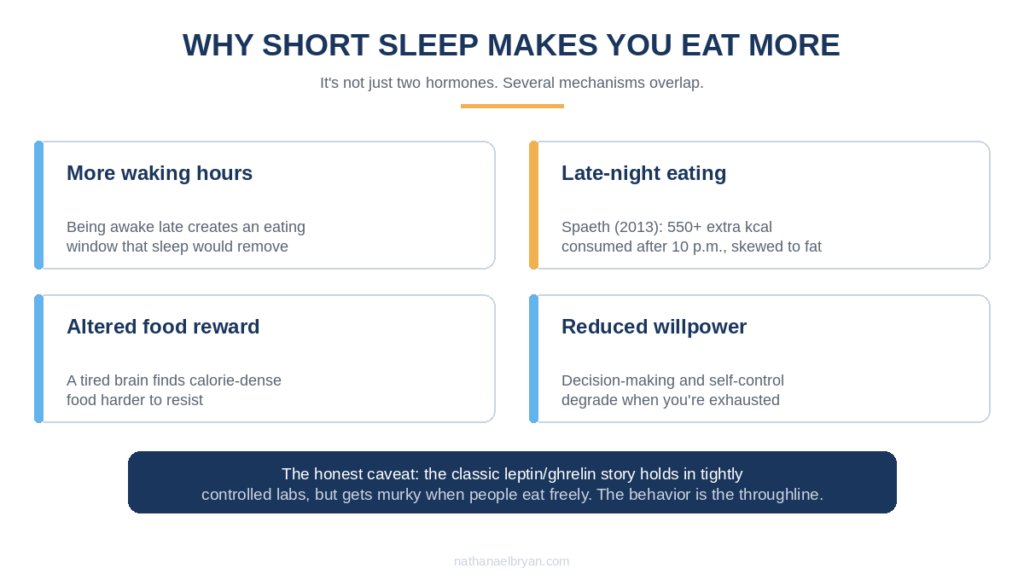
But here’s the caveat that honest practitioners include and salespeople leave out. That study, and others like it, controlled food intake tightly, sometimes delivering energy intravenously rather than through normal eating. When researchers later studied sleep restriction under more realistic conditions, with people simply free to eat, the hormonal picture got murky. Several of those studies found no consistent change in ghrelin or leptin, and some even found leptin going up rather than down (see the discussion in the appetite literature, e.g. CHAPUT, 2014). In other words, the neat two-hormone narrative doesn’t hold up cleanly outside the tightly controlled lab.
So what’s actually going on? The most reasonable read of the full body of evidence is this: the increase in eating from short sleep is real and well documented, but it’s probably driven by more than just two hormones. Extended waking hours give you more opportunity to eat, especially late at night. Tired brains show altered reward responses to food, making the cookie harder to resist. Willpower and decision-making degrade when you’re exhausted. The hormones may play a role, but the behavior is the throughline, and the behavior is what you can actually work with.
This matters because it keeps us honest. The takeaway isn’t “fix these two hormones.” It’s “short sleep reliably nudges you toward eating more, through several overlapping mechanisms, so protecting your sleep protects your diet.”
The late-night eating problem
Remember that detail from the Spaeth study, the extra calories landing after 10 p.m.? That’s worth its own moment, because it’s where sleep and fat loss intersect in the most practical way.
When you stay up late, you create a window of time that simply doesn’t exist for someone who’s asleep. And that window tends to get filled with food, often the worst kind. In the Spaeth data, the late-night calories skewed toward fat, and the sheer act of being awake during hours you’d normally be sleeping was enough to pile on hundreds of extra calories (SPAETH; DINGES; GOEL, 2013).
This is the obesogenic environment doing what it does. Late at night, tired, willpower spent, with a fully stocked kitchen a few steps away, the deck is stacked against you. Going to bed at a reasonable hour isn’t just about the sleep itself. It physically removes one of the most dangerous eating windows of the day.
What this means for you, practically
None of this requires a sleep lab or a supplement stack. The evidence points to something refreshingly direct: if you habitually sleep less than about seven hours, getting closer to seven to nine is one of the highest-leverage changes you can make for fat loss, and one of the few that doesn’t involve eating less on purpose.
A few grounded takeaways from the research:
Treat sleep as part of your diet, not separate from it. The Tasali trial showed that better sleep alone produced a meaningful caloric deficit. Most people obsess over the food and ignore the upstream factor quietly inflating how much of that food they eat.
Protect your bedtime specifically, not just total sleep. The late-night hours are where the damage concentrates. An earlier bedtime closes the most dangerous eating window and tends to increase total sleep at the same time.
Don’t expect sleep to override the fundamentals. Better sleep makes the deficit easier to reach and maintain. It does not replace it. The energy balance still has to be there. Sleep just stops working against you.
If you’re using a GLP-1 medication, this still applies. These medications suppress appetite powerfully, but poor sleep works against your results on a different axis, through cravings, willpower, and late-night eating. They’re not mutually exclusive problems. I wrote about how those medications actually work here, if you want the full mechanism.
The honest bottom line is this. Sleep won’t melt fat off you, and anyone promising that is selling something. But poor sleep can quietly add hundreds of calories to your day and make every other part of fat loss harder than it needs to be. Fix it, and you remove a saboteur you might not have known was there.
If you want a strategy that accounts for all of this, sleep, nutrition, training, and the behavior underneath it, built around your actual life rather than a generic template, that’s the work I do with my patients. We adjust it as often as needed until it’s genuinely working for you. You can see how my coaching works here. And if you’d rather start by learning the fundamentals yourself, my educational materials are here, along with a free calculator to estimate your own numbers.
References
CHAPUT, J.-P. Sleep patterns, diet quality and energy balance. Physiology & Behavior, v. 134, p. 86–91, 2014. Available at: https://www.ncbi.nlm.nih.gov/pmc/articles/PMC4098122/. Accessed: 15 jun. 2026.
SPAETH, A. M.; DINGES, D. F.; GOEL, N. Effects of experimental sleep restriction on weight gain, caloric intake, and meal timing in healthy adults. Sleep, v. 36, n. 7, p. 981–990, 2013. Available at: https://pmc.ncbi.nlm.nih.gov/articles/PMC3669080/. Accessed: 15 jun. 2026.
SPIEGEL, K.; TASALI, E.; PENEV, P.; VAN CAUTER, E. Brief communication: sleep curtailment in healthy young men is associated with decreased leptin levels, elevated ghrelin levels, and increased hunger and appetite. Annals of Internal Medicine, v. 141, n. 11, p. 846–850, 2004.
ST-ONGE, M.-P.; ROBERTS, A. L.; CHEN, J. et al. Short sleep duration increases energy intakes but does not change energy expenditure in normal-weight individuals. American Journal of Clinical Nutrition, v. 94, n. 2, p. 410–416, 2011.
TASALI, E.; WROBLEWSKI, K.; KAHN, E.; KILKUS, J.; SCHOELLER, D. A. Effect of sleep extension on objectively assessed energy intake among adults with overweight in real-life settings: a randomized clinical trial. JAMA Internal Medicine, v. 182, n. 4, p. 365–374, 2022. Available at: https://jamanetwork.com/journals/jamainternalmedicine/fullarticle/2788694. Accessed: 15 jun. 2026.