Every January, the same promise floods your feed. A juice cleanse to flush out toxins. A tea to detox your liver. A protocol to reset your system after the holidays. The language is always vaguely medical and always conveniently undefined. Which toxins, exactly? Flushed to where? Reset from what?
The detox industry thrives precisely because it never has to answer those questions. It sells a feeling, not a fact. And to understand why it works so well on intelligent people, it helps to step back nearly two and a half thousand years, to a conversation that has nothing to do with juice and everything to do with why we fall for this.
The shadows on the wall
In Book VII of The Republic, Plato describes prisoners chained in a cave, facing a blank wall. Behind them, figures pass before a fire, casting shadows. The prisoners, having never seen anything else, take the shadows for reality. They become experts in the shadows, naming them, predicting them, mistaking the flicker for the thing itself (PLATO, Republic, Book VII).
The detox industry sells shadows. The feeling of doing something healthy, the ritual of the cleanse, the temporary lightness after three days of juice. These are the flickers on the wall. People mistake them for health itself. And like Plato’s prisoners, they can become quite attached to the shadows, even hostile to anyone who suggests there’s a sunlit world of actual physiology behind them.
The philosopher’s task, Plato wrote, is to turn toward the light and see what’s casting the shadows. So let’s do exactly that. Let’s turn around and look at what’s really there.
What’s actually casting the shadow: your liver and kidneys
Here is the truth the industry desperately needs you not to know: you already own the most sophisticated detoxification system ever devised, and it runs continuously, for free, without a single juice.
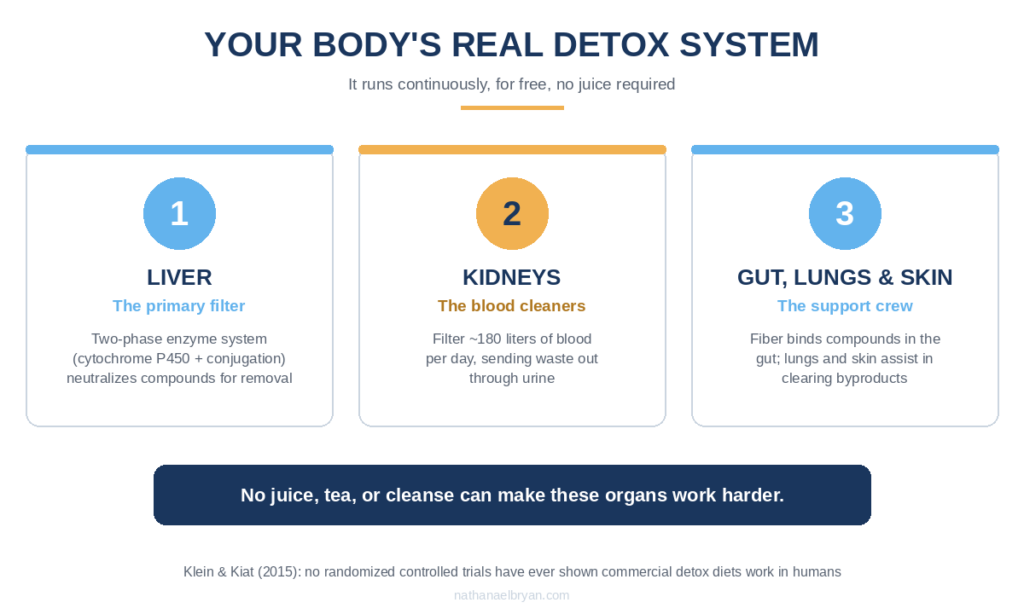
Your liver is the primary organ of biotransformation. It processes everything that enters your bloodstream through a two-phase enzymatic system. Phase one, driven largely by the cytochrome P450 enzyme family, chemically alters compounds. Phase two attaches molecules that make those compounds water-soluble so they can be excreted. Your kidneys then filter your blood, roughly 180 liters of filtrate a day, sending waste out through urine. Your gut, your lungs, and your skin assist. This system handles genuine toxins, metabolic byproducts, medications, alcohol, and environmental compounds, around the clock, whether you’re awake or asleep, juicing or not.
A juice cleanse does not enhance this. It cannot. There is no mechanism by which celery and lemon instruct your cytochrome P450 enzymes to work harder. The claim isn’t merely unproven; it’s physiologically incoherent. When researchers Klein and Kiat (2015) conducted a critical review of the evidence for detox diets in the Journal of Human Nutrition and Dietetics, they reached a blunt conclusion: there is very little clinical evidence to support these diets, and to their knowledge, no randomized controlled trials had ever been conducted to assess the effectiveness of commercial detox diets in humans (KLEIN; KIAT, 2015). The handful of supportive studies they found were, in their words, hampered by flawed methodologies and small sample sizes.
Sit with that. The entire multi-billion-dollar industry rests on a body of evidence its own sympathetic reviewers describe as methodologically broken.
Aristotle and the problem of the extreme
If Plato explains why we mistake the feeling of health for health, Aristotle explains why the cleanse is the wrong action even when the goal is right.
In the Nicomachean Ethics, Aristotle argued that virtue lies in the mean between two extremes, what later thinkers called the golden mean. Courage sits between cowardice and recklessness. Health, in eating, sits between gluttony and starvation (ARISTOTLE, Nicomachean Ethics, Book II). The good is not found by lurching from one extreme to its opposite. It’s found in the sustainable middle.
The detox cleanse is the philosophy of the extreme dressed up as wellness. You overindulge for a season, then punish yourself with a juice fast. Feast, then purge. It’s a pendulum, and the pendulum is precisely what Aristotle warned against, because it never settles into the stable habit, the hexis, where real virtue and real health actually live.
This isn’t just ancient theory. The cleanse fails on its own terms. A 2017 review of weight-loss strategies found that juicing and detox diets can produce short-term weight loss, but only through extreme caloric restriction, and the weight is typically regained the moment normal eating resumes (OBERT et al., 2017). The “results” are water and an empty digestive tract, not fat, and they evaporate in days. The pendulum swings back, exactly as Aristotle would have predicted. If you want to understand why only a sustained, moderate approach actually changes your body, I laid out the full mechanism in my article on how fat loss actually works.
The cruel irony: the cleanse can poison the thing it claims to clean
Here the story turns from merely useless to genuinely dangerous, and the irony is almost too perfect.
The products sold to “detoxify” and “cleanse” your liver are, in reality, one of the leading causes of liver injury in the United States.
The Drug-Induced Liver Injury Network, a major prospective study run across eight U.S. referral centers, tracked patients with liver injury between 2004 and 2013. Navarro and colleagues (2014) found that herbal and dietary supplements accounted for a substantial and rising share of cases, with the proportion of liver injury attributed to these supplements climbing over the study period (NAVARRO et al., 2014). Subsequent work from the same network put herbal and dietary supplements at roughly 20% of all hepatotoxicity cases in the country. Among the most common culprits: green tea extract and multi-ingredient “wellness” supplements of exactly the kind marketed for cleansing.
It gets worse. When the network chemically analyzed the actual contents of these supplements, it found that 51% were mislabeled, their real chemical contents not matching what the bottle claimed (NAVARRO et al., 2019). So you swallow a product to purify your body, the product is one of the top causes of liver damage in the nation, and there’s a coin-flip’s chance it doesn’t even contain what the label says. The organ you were trying to “cleanse” is the very one in the crosshairs.
There is a dark comedy here that the Stoics would have appreciated: in our anxious pursuit of purity, we manufacture the harm we feared. The toxin was never in your bloodstream. It was on the supplement shelf.
Augustine, anxiety, and the appetite for a quick cleansing
Why does this myth persist against all evidence? Saint Augustine offers a clue that runs deeper than nutrition.
Augustine understood the human longing to be cleansed, made new, washed of past excess. In the Confessions, he traces his own restless search for a shortcut to peace, a way to be made whole without the slow, difficult work of genuine change (AUGUSTINE, Confessions). He found, eventually, that there is no shortcut, that real transformation is patient, ongoing, and earned.
The detox cleanse is a counterfeit of that ancient longing. It promises absolution for the holiday binge, a clean slate, a reset, in three days and one click. It speaks to something real, the genuine human wish to undo our excesses and begin again. But it answers that wish with a lie. The body doesn’t need absolution from a juice. It needs the patient, unglamorous, sustainable habits that no one can sell you in a bottle, because they aren’t a product. They’re a practice.
What the science actually recommends
Turn fully toward the light, and the real protocol is almost insultingly simple. It just can’t be branded or sold at a markup.
Support the detoxification system you already have. Drink enough water so your kidneys can do their filtering. Eat adequate protein and the micronutrients your liver’s enzymes actually require to function. Eat plenty of fiber, which genuinely binds compounds in the gut and carries them out, the one mechanism in this whole conversation that actually works as advertised, and it comes from vegetables, not a powder.
Limit the real hepatotoxins. Alcohol is a genuine liver toxin. Excess body fat drives non-alcoholic fatty liver disease. If you actually care about your liver, moderating alcohol and losing excess fat will do more than every cleanse ever sold, combined.
Sleep. Your body does enormous restorative work during sleep, and I covered the strong randomized evidence for sleep’s role in metabolic health in my article on sleep and fat loss.
And be deeply skeptical of anything sold to you as a “cleanse” or “detox.” The word, in a commercial context, is a marketing term with no agreed clinical meaning. That alone should tell you what you’re buying: a shadow on the wall.
If you want to stop chasing shadows and build the kind of sustainable, evidence-based practice that actually changes your health, that’s the work I do with my patients, individualized, adjusted over time, grounded in physiology rather than marketing. You can see how my coaching works here. If you’d rather start by learning the fundamentals yourself, my educational materials are here, and you can estimate your own numbers with my free calculator.
The truth is less exciting than the promise. It always is. But unlike the shadows on the cave wall, it has the considerable advantage of being real.
References
ARISTOTLE. Nicomachean Ethics. Translated by W. D. Ross. Book II. Various editions.
AUGUSTINE OF HIPPO. Confessions. Translated by Henry Chadwick. Oxford: Oxford University Press, 1991.
KLEIN, A. V.; KIAT, H. Detox diets for toxin elimination and weight management: a critical review of the evidence. Journal of Human Nutrition and Dietetics, v. 28, n. 6, p. 675–686, 2015. Available at: https://pubmed.ncbi.nlm.nih.gov/25522674/. Accessed: 15 jun. 2026.
NAVARRO, V. J.; BARNHART, H.; BONKOVSKY, H. L. et al. Liver injury from herbals and dietary supplements in the U.S. Drug-Induced Liver Injury Network. Hepatology, v. 60, n. 4, p. 1399–1408, 2014. Available at: https://pubmed.ncbi.nlm.nih.gov/25043597/. Accessed: 15 jun. 2026.
NAVARRO, V. J.; AVULA, B.; KHAN, I. et al. The contents of herbal and dietary supplements implicated in liver injury in the United States are frequently mislabeled. Hepatology Communications, v. 3, n. 6, p. 792–794, 2019. Available at: https://pmc.ncbi.nlm.nih.gov/articles/PMC6545864/. Accessed: 15 jun. 2026.
OBERT, J.; PEARLMAN, M.; OBERT, L.; CHAPIN, S. Popular weight loss strategies: a review of four weight loss techniques. Current Gastroenterology Reports, v. 19, n. 12, p. 61, 2017. Available at: https://pubmed.ncbi.nlm.nih.gov/29124370/. Accessed: 15 jun. 2026.
PLATO. The Republic. Translated by Benjamin Jowett. Book VII. Various editions.