You were losing weight, the scale was cooperating, and then one day it simply stopped. That stall has a name, and a weight loss plateau is one of the most discouraging moments in any fat loss journey, because you feel like you are doing everything right and getting nothing back for it.
So you start reaching for explanations. Maybe my metabolism is broken. Maybe I have slipped into starvation mode and my body is now clinging to every calorie I give it. Those stories are everywhere, and they are mostly wrong. Your body is doing something far more ordinary, and once you see what it is, the plateau stops feeling like a curse and starts looking like a problem you can actually solve.
Let me walk you through the six real reasons the scale stops, what the research says about each, and exactly what to do about it.
What a weight loss plateau actually is (and what it isn’t)
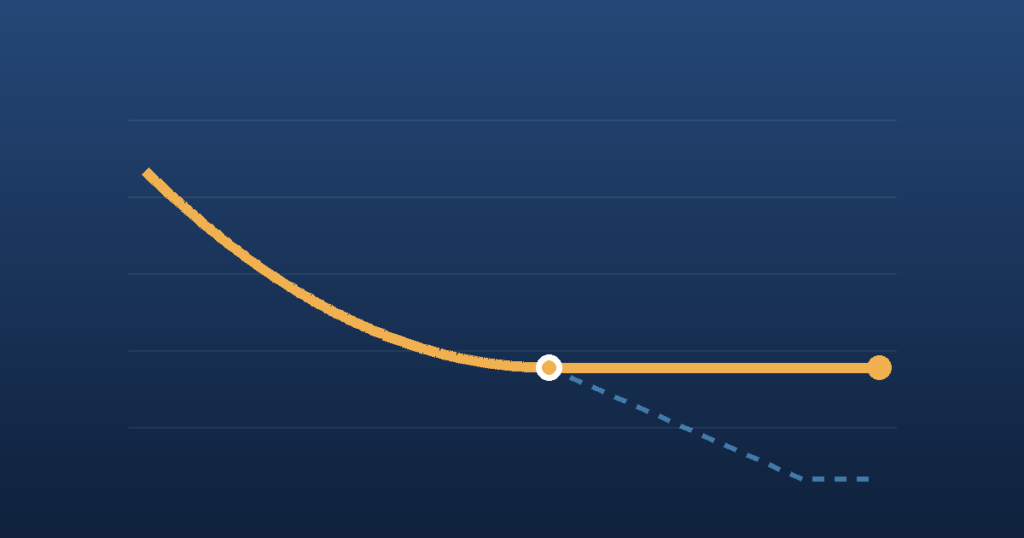
A weight loss plateau is what happens when your weight holds steady for a stretch of weeks even though you are still trying to lose. Not a couple of flat days. A genuine stall in your weekly average across three to four weeks or more.
The part that matters is this. A plateau is not your metabolism shutting down. It is energy balance closing back up. Early on, you were eating less than your body burned, so fat came off. A plateau means that, for now, the energy you take in has crept back up to meet the energy you burn. The gap closed. Nothing is broken. The job is to figure out why it closed, and open it again.
That single shift in framing changes everything, because it points you at causes you can fix instead of a phantom you cannot.
Reason 1: You’re smaller now, so you burn less
Start with the simplest reason, the one almost nobody accounts for. A smaller body costs less energy to run and less energy to haul around.
When you weighed more, just existing burned more calories, and every flight of stairs cost more. Lose eight or ten kilos and all of those numbers come down with you. The deficit that melted fat in month one can quietly shrink toward zero by month three. Not because anything went wrong, but because you are now a lighter person who needs less fuel than the person who started.
This is normal, predictable, and easy to correct once you know to look for it.
Reason 2: Your metabolism adapted (a little)
On top of being smaller, your body also burns slightly less than its new size alone would predict. Scientists call this adaptive thermogenesis, and it is real. As you lose weight, the hormones that govern energy use shift, leptin falls, thyroid output dips a little, and your body becomes a touch more efficient, defending its fat stores more stubbornly (Rosenbaum & Leibel, 2010; Trexler et al., 2014).
You have probably heard this one taken to an extreme. The famous “Biggest Loser” follow-up found that contestants were burning roughly 500 calories a day less than expected for their body size, even six years later (Fothergill et al., 2016). That study gets quoted constantly, and it frightens people. But it is worth being honest about what it actually shows. Those were extreme cases, enormous amounts of weight lost very fast under punishing conditions. For someone losing weight at a sane pace, adaptation is real but far smaller, and it does not sentence the scale to stop forever.
So yes, your metabolism adapts. No, it has not betrayed you, and no, a modest dip in expenditure cannot keep you from losing fat if your deficit is genuinely there.
Reason 3: You’re moving less without noticing it
This reason is sneaky, because it operates completely below your awareness. When you are in a calorie deficit, your body quietly turns down the dial on all the small movement you do without thinking about it. Researchers call it NEAT, the energy you spend fidgeting, shifting in your chair, pacing on the phone, gesturing, taking the stairs instead of the lift (Trexler et al., 2014).
Diet for a few weeks and you start, unconsciously, to sit a little stiller. You take fewer steps across the day. You stand around less. None of it feels like a decision, yet together it can quietly erase a few hundred calories, which is more than enough to settle a plateau into place.
Your training might be identical week to week. It is the other eighteen hours of the day that changed.
Reason 4: You’re eating more than you think
Now the big one, and I mean the big one. For most people who swear they are stuck despite eating next to nothing, the honest answer is that they are eating considerably more than they believe they are.
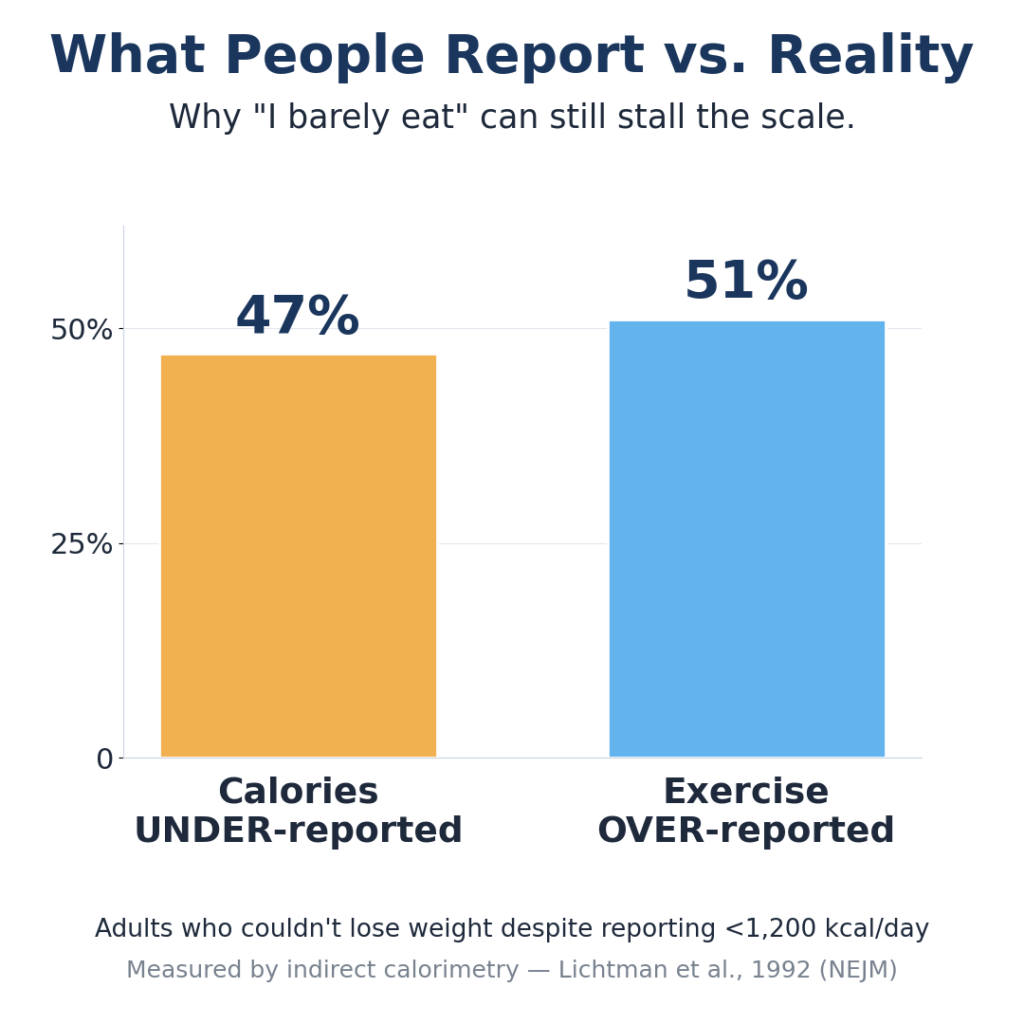
That is not an insult, it is human, and there is striking research behind it. In a now-classic study, people who could not lose weight despite reporting that they ate under 1,200 calories a day were brought into a lab and measured directly. They were under-reporting what they actually ate by an average of 47 percent, and over-reporting their exercise by 51 percent. Their metabolisms were completely normal (Lichtman et al., 1992).
It happens through a thousand small leaks. The handful of nuts you did not log. The oil in the pan. The bites off your kid’s plate. The two good weekend meals that quietly undo five tidy weekdays. The splash of this, the taste of that. None of it feels like eating, and all of it counts toward the total your body actually sees.
When the scale stops, this is the first place to look, not the last.
Reason 5: Water is hiding your fat loss
Sometimes you really are losing fat, and the scale just refuses to show it, because water is sitting right on top of the result.
Your body holds and releases water for all kinds of reasons that have nothing to do with fat. A new or harder workout, a salty meal, more carbs than usual, a bad night of sleep, stress and the cortisol that rides along with it, and the menstrual cycle can each add a kilo or two of water and hold it there for days, sometimes a couple of weeks. Underneath that water, fat can be coming off the entire time. Then the water flushes, occasionally overnight, and the scale suddenly catches up in one jump.
The scale is not lying to you. It just weighs everything at once, and water is loud enough to drown out a quiet week of real fat loss.
Reason 6: You’re not actually plateaued
Which leads straight to the last reason, and it is the one I see most of all. A great many “plateaus” are not plateaus at all. They are ordinary noise being read as a verdict.
Your weight swings every single day. A kilo or two up or down from water, food still moving through your gut, salt, and timing is completely normal and means nothing by itself. If you weighed yesterday, weighed again today, and panicked at the number, that is not a plateau, that is just Tuesday. A real plateau is a flat weekly average held across three to four weeks while you are genuinely sticking to the plan. Anything shorter is too small a window to tell you anything at all.
How to break a weight loss plateau
Here is the practical part. If the scale has truly stalled, work through this list in order, because the first few steps end the large majority of plateaus on their own.
First, confirm it is real. Look at your weekly average across three to four weeks, not the day to day. Weigh yourself the same way most mornings and follow the trend, not the noise.
Second, audit your intake honestly. For one or two weeks, weigh and log everything that goes in your mouth, including the oils, sauces, drinks, and the bites you usually wave away. Most plateaus quietly end right here, because the leaks finally become visible and you can plug them.
Third, recalculate your numbers for the body you have now, not the one you started with. A lighter you needs fewer calories, so the targets that worked in month one need an update. You can re-run yours with my free calorie calculator and reset your deficit from there.
Fourth, protect your muscle. Keep your protein high and keep lifting, because losing muscle is what makes the metabolic side of this worse and softens the way your body looks. If you are not sure how to balance your training for that, I broke it down in cardio versus weights for fat loss.
Fifth, put some movement back. Nudge your daily steps upward, since that quiet drop in NEAT is so often the hidden culprit behind a stall.
Sixth, if you have been dieting hard for a long stretch, a short and structured break at maintenance calories can help. It gives both your adherence and your hormones a breather. Just stay clear-eyed about what it is. It supports the process, it is not a magic reset that repairs a metabolism that was never broken.
And then the unglamorous truth, the one no one wants to hear: be patient. Real fat loss moves in steps and stalls, not a straight line pointing down.
The honest version
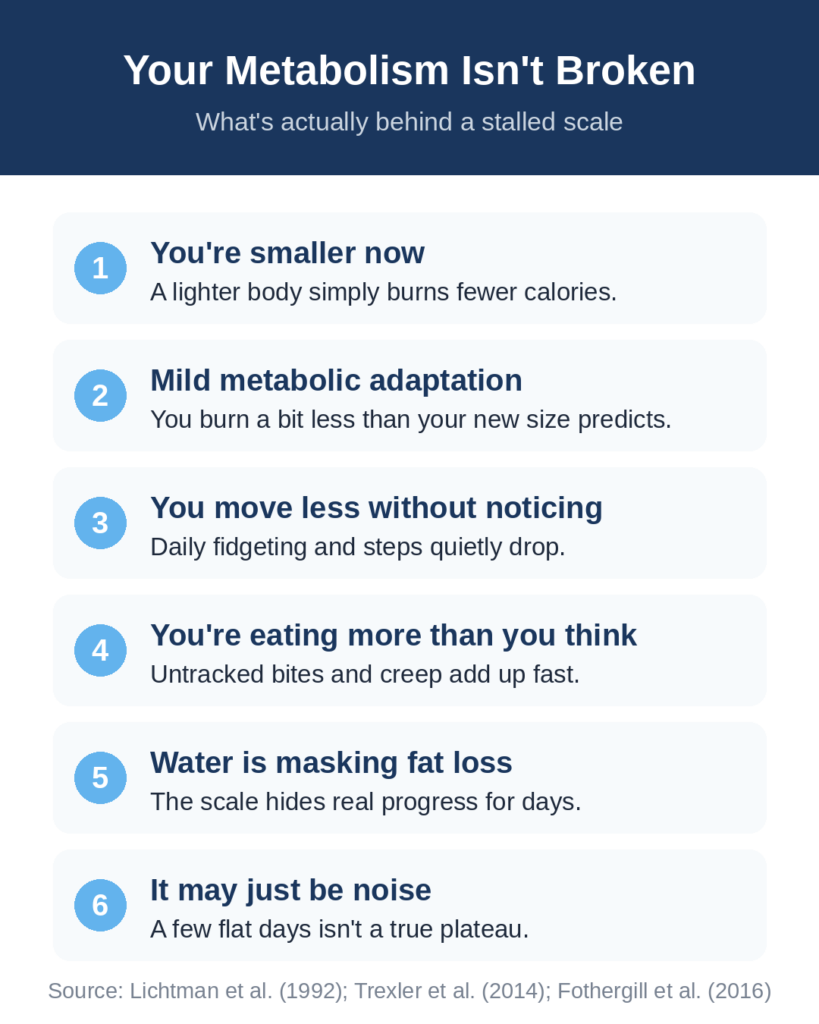
A weight loss plateau feels like your body turning against you. Underneath the frustration, it is just energy balance quietly re-equalizing, dressed up by water and day-to-day noise. Your metabolism adapts a little, you burn less as you shrink, you move a bit less without realizing it, and you almost certainly eat a bit more than you think. Add it all up and the scale parks itself. None of it is mysterious, and none of it is permanent.
The fix is rarely dramatic. Confirm the stall is real, get honest with your intake, update your numbers for your new size, defend your muscle, and keep showing up. This is a long game, and the people who win it are the ones who stop hunting for a secret and trust the basics long enough to let them work.
If you would rather not untangle this on your own, building a plan around your body, your numbers, and your real life is exactly the work I do with clients inside one-on-one nutrition coaching. And if you want to understand the principles for yourself first, my books and courses lay the whole thing out, step by step.
References
FOTHERGILL, E. et al. Persistent metabolic adaptation 6 years after “The Biggest Loser” competition. Obesity, v. 24, n. 8, p. 1612-1619, 2016. DOI: 10.1002/oby.21538.
LICHTMAN, S. W. et al. Discrepancy between self-reported and actual caloric intake and exercise in obese subjects. The New England Journal of Medicine, v. 327, n. 27, p. 1893-1898, 1992. DOI: 10.1056/NEJM199212313272701.
ROSENBAUM, M.; LEIBEL, R. L. Adaptive thermogenesis in humans. International Journal of Obesity, v. 34, suppl. 1, p. S47-S55, 2010. DOI: 10.1038/ijo.2010.184.
TREXLER, E. T.; SMITH-RYAN, A. E.; NORTON, L. E. Metabolic adaptation to weight loss: implications for the athlete. Journal of the International Society of Sports Nutrition, v. 11, n. 1, art. 7, 2014. DOI: 10.1186/1550-2783-11-7.